Stop-Loss (2008): The End of Denial or The War that Takes Place in Living rooms

Stop-Loss

“Sand, fleas, flies, heat, boredom. Or you can get shot at. Or blown up. That’s pretty much it. There are sheep on the highway”, says SSgt. Brandon King (a remarkable Ryan Philippe) in Stop-Loss after Steve’s girlfriend tells him that Steve doesn’t talk much about being over there. Brandon doesn’t go into details, he sums it up and turns it into a joke. It’s difficult to talk about it. And not even wanted as his father tells Brandon when he is getting too graphic. There is denial in both camps. Those who stay home do not want to know because they want to believe in their sons/lovers/friends/brothers doing the right thing. To be invulnerable heroes and return as such. Nothing really bad happens over there, right? Soldiers like Steve do not want to talk about it because they simply do not want to think about it. As soon as they start thinking, like Brandon does, the only thing they want is: getting out! And that’s when the trouble begins

Brandon has seen it all. His people dying, being terribly wounded and crippled for life. Dead civilians. The war taking  place in living rooms. He’s done his job. He returns from a completed tour of duty in Iraq a hero and now he wants out. Unfortunately he is stop-lossed. In times of war, when there is no draft and not enough volunteers, the government can stop-loss soldiers, meaning send them back even if they want out.

What begins as a war movie with heavy fighting, interspersed with grunt-video like elements, turns now into a road movie. Brandon wants out and goes AWOL.

He and his best buddies girlfriend Michelle are taking a trip to… A new life with a fake identity or back to where his friends are?

Watch it and you will find out. It should suffice to say that this movie is a character study, a very critical look at what is going on “over there” and a way out of the speechlessness of those involved and those waiting for them. The young men, depicted in this movie are of the kind who rather hit you in the face than voice their uneasiness. They drink, they fight, they like to shoot guns and listen to heavy music. They are self-destructive but loyal friends. They do not have much other professional options but join the army.

The movie’s strength is not only to be highly watchable but to convey a deep feeling of  sadness. Sadness about many things: the loss of naivety,  the governments cheating, the waste of lives and ultimately hope.
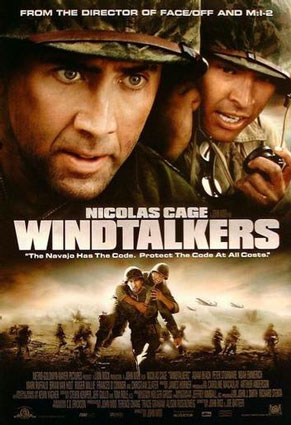
Is There Such A Thing as a Bad War Movie? Windtalkers (2002)


This is one of my worst war movie experiences and probably even one of the worst movies in general. Already under normal circumstances (meaning when he does some decent acting of which he is capable) I’m not really a Nicolas Cage fan but in this movie his acting is frankly ridiculous. This is a parody of suffering and you don’t believe one second that his character is in pain. Definitely not from shell shock. Maybe one would believe it if someone informed you he had a bad case of piles. I had been told that this is not a good movie, although it has his followers, but I didn’t imagine it could be this flawed. There’s bad acting, a lot of explosions that seem to happen for no reason and a stupid plot twist when the Indian code talker plays a Japanese and enters the Japanese  dugout with Nicolas Cage’s character in tow. Unconvincing? Embarrassing!

Enough slagging off. What is it about and why did I not listen to the ones who told me? Purely because I’m interested in the history of the North American Indians. Apparently they had successfully been used as code talkers during WWII. A valuable asset to the American Army. Codes and code breakers  are a vital element in any war (nicely shown in Enigma). Windtalkers tells the story of two Indian code talkers and their counterparts or body guards so to say during the battle of Saipan in the Pacific. But this is only what the Indians are told they are. On a deeper level those two men (one the insufferable Nicolas Cage and the other the convincing  – as always- Christian Slater) are not only guardians  but ultimately they could become executors. Since it would be fatal should the code get into the hands of the enemy,  the men must see that those Indians are not taken prisoners under any circumstances and are  killed in the event of  imminent capture.  This creates a lot of moral tensions. Would they really do it?

The only good bit was the rites you see the Indians perform. What a pity. Had John Woo  managed to tell us something like Glory does about the African-American soldiers’ participation in the Civil War… What a movie this would have been…well…he didn’t.

On Death and Dying or Why War Movies Teach us a Buddhist Lesson

Without any doubt there will be death and dying in a war movie. As a cultural anthropologist it often struck me how different other cultures handle death. In a society like ours,  in which death is a taboo (there seems to be an even greater taboo when it comes to dying) the war movie is one of the rare places where it is shown with such frequency. When it comes to movies in general  there is only the action and thriller/crime genre where you can count on death with the same certainty only not in such abundance.  Else you are left with rare films about illness, very rarely you’d see an old person dying or, more likely, already dead. A few deal with accidents or rather their consequences  like Atom Egoyan does in The Sweet Hereafter.

I did often wonder where my interest in war movies came from, besides from the urge to understand what happened, why it happened and how it felt for those involved. I think that they teach us a lesson in non-attachment. You see characters that you get to know and like and you know that for sure some of them are going to die. And death seems, for our human eye,  not to choose very carefully in whom he spares and whom not. In the war movie we see death and dying in a magnified overdrawn way. There is everything you could see in daily life: quick death, painful death, slow and agonising dying. Nothing is left out. If you go one step further it makes you contemplate your own perishability. A further lesson in non-attachment.

In the Tibetan Book of Living and Dying Sogyal Rinpoche teaches that it is a good exercise to picture ones own death on a daily basis. It is maybe the most fundamental aim in life to have a good death.

I think it is not arbitrary that the late great American journalist Studs Terkel did as well a book on The Good War: An Oral History of World War II as on Death, Will the Circle be Unbroken: Reflections on Death, Rebirth and Hunger for  a Faith.

For anyone who would like to pursue his/her own reflections on this topic a few more or less random reading suggestions:

The Tibetan Book of Living and Dying Sogyal Rinpoche, 1992

The Pagan Book of Living and Dying Starhawk, 1997

On Death and Dying Elisabeth Kuebler Ross, 1997

R.I.P. – The complete book of death and dying Constance Jones, 1997

Dancing on the Grave: Encounters with Death Nigel Barley, 1995

Tuesdays with Morrie: An Old Man, a Young Man, and Life’s Greatest Lesson Mitch Albom, 1997

Will the Circle be Unbroken: Reflections on Death, Rebirth and Hunger for a Faith Studs Terkel, 2001

Swimming in a Sea of Death: A Son’s Memoir David Rieff, 2008

Staring at the Sun: Overcoming the Terror of Death Irvin D. Yalom, 2008

The Year of Magical Thinking Joan Didion, 2005

Noch eine Runde auf dem Karussel: Vom Leben und Sterben Tiziano Terzani, 2007

Das Ende ist mein Anfang: Ein Vater, ein Sohn und die grosse Reise des Lebens Tiziano Terzani, 2006

Der Tod meiner Mutter Georg Diez, 2009

Das westliche Totenbuch Irene Dalichow, 2001

When Trumpets Fade (1998)

Eerily beautiful is what comes to mind when speaking about this overlooked war movie gem. I discovered it thanks to Gary Freitas’ book on war movies.

The movie starts with black and white original footage and a voice telling us that it is 1944, just after Paris has been liberated.

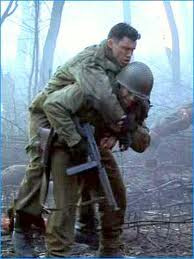
After this introduction we are thrown into action and see one soldier, private Manning (Ron Eldard),  carrying his mortally wounded comrade whom he finally must abandon. All through watching this movie I was reminded of Goethe’s ballad the Erlkoenig in which a father rides with his son through the woods at night. The child keeps on saying it sees the Erlkoenig in the darkness who tries to tempt him and take him away. A very spooky ballad. When the father finally arrives at his destination he finds out that his little son has died in his arms.

Maybe John Irvin, the director, did think of this ballad when he shot this movie. The woods always had a special place in German mythology and references to this can be found in many a movie or book about WWII.

The soldiers in this movie are fighting a senseless battle, one that cost a horribly high amount of lives. The battle of Hurtgen forest is only not spoken about so often since it was shortly followed by the more famous Battle of the Bulge.

When Trumpets Fade tells the story of private Manning the only survivor of his company who is – due to his ability to survive under such circumstances – promoted to sergeant and gets to lead a group of replacements. In a bloody battle where they are to secure a bridge he is again one of the only survivors and gets promoted to lieutenant. Both times he protests. All he wants is to survive and  get out. He’s not the only unhappy soldier. The battle seems sense- and fruitless, casualties are high, soldiers and officers complain and rebel.

Manning is a very interesting character and his development makes this movie one of the rare psychologically interesting of its kind. This and the eerie scenes in the woods where the fog is thick, Germans lurking everywhere and naked, burning trees stand lonely and dark against the background,  makes this a haunting experience to watch.

The final credits are shown over endless rows of dragon’s teeth that are slowly covered in snow to  Bing Crosby singing White Christmas.

Mean Old Private Ryan

People did talk about Saving Private Ryan. They talk about it and they will continue to talk about. Occasionally it seems that it is the only war movie that has ever been made. At least the only one the general public is aware of  – until, of course The Hurt Locker got the Oscar – but that is another story and if I believe it deserved it…). It is a fact that even the most war movie illiterate seems to know Saving Private Ryan or has at least heard  of it. One could almost go as far as to talk about a before and after era. Occasionally this can become slightly annoying especially considering that this movie overshadows some very well done other movies that would be talked about, appreciated and mentioned if it wasn’t for mean old Private Ryan.  On top of that it  led to my worst Popcorn moment ever, something that up to that point in time  I wouldn’t even have thought possible and , by the way, was never repeated since. I was on holiday in  some southern English town. Salisbury or Bournemouth. At the beginning of the movie I was actually  sitting in one of the rows in the middle munching Popcorn.  Shamefully I must admit that I was not aware of the nature of the movie that would be shown (How could that happen? Living in Switzerland which I did at the time and am doing again now doesn’t really put you in the position to talk about the latest releases of the film industry. US movies are usually already classics by the time Swiss  movie theaters start to show the previews). Fifteen minutes into the beginning of the movie it dawned on me: Popcorn was the least appropriate thing when watching a movie like this. And everybody knows what I’m talking about when referring to the first 15 minutes of Private Ryan. This is probably one of the most hellish moments in the history of war movies (put aside the episode Bastogne in Band of Brothers) and what’s even worse: There is no escaping it. You don’t watch it , you’re literally in it. These 23 minutes are very probably part of its success story. They lead to  an extremely close  and  maybe for some spectators  totally unwanted identification with those poor unfortunate soldiers landing on  Omaha Beach. A nightmare and absolutely not encouraging popcorn eating. I almost threw up.

After having said all this, adorned with some little anecdote of the life of a moviegoer, I’d like to put this straight: I do appreciate Saving Private Ryan. It is one of the best WWII infantry combat movies, no doubt about that, but it is just unfair it gets all the credit when The Thin Red Line is so much more emotional and poetic, and When trumpets fade so much more moving. Ahh… I hear some of you wonder …When trumpets fade… ?What the heck is she talking about?…See? Overshadowed by Saving Private Ryan. 1998. What a year for war movies.