The Guns of Navarone (1961): A Great War Adventure Movie

Some movies age well. Others don´t. The Guns of Navarone,  a splendid UK/US co-production, is one of the first kind. Almost 50 years old but still fresh like on the day it came out. This is thanks to a  lot of things. A gripping story, a great cast (Gregory Peck, David Niven, Anthony Quinn, Irene Papas, Stanley Baker, Anthony Quayle), wonderful cinematography, a nice score. What more do you want from a good war adventure yarn? I hadn’t  seen it before (yes, yes, shame on me) and was really surprised how good it is. And very esthetic. It is one of the most esthetic movies I have ever seen.

The year is 1943. Greece is occupied by Germany.  The Germans who feel they are losing on the Eastern Front try to force Turkey to join them. The Guns of Navarone tells us how a group of men tries to secretly enter a Greek island, meet with the Greek resistance and with their help sneak into a fortress to destroy two powerful German guns that threaten British soldiers who are marooned on another island. The mission is extremely dangerous and no one actually thinks they might accomplish it.

The story, from the beginning to the end, is one gripping sequence after the other. Each one of them could almost stand alone like some sort of short story. First they fight the elements on a boat during a storm. Then they have to climb an impossibly steep rock. Every place they find themselves in is swarming with Germans so they have to hide often.  In one episode one of them gets wounded and they need to decide if they take him along or shoot him. One of them betrays them and they need to decide whether or not to shoot the person. They get captured by the Germans but escape. Many things go wrong and not all of them make it. The best scenes for me are in the fortress. We hear a German song in the background and see this bunker with its typical Nazi esthetics.

It is also a funny movie at times as the German´s really get their asses kicked. In one scene the group is hiding and a German guard hears them. To distract  him they throw something and he runs off like a dog.

There is also some humorous dialogue mostly coming from the stiff-upperlipped British major played by David Niven.

The characters are well drawn, interesting and complex. Major Mallory (Peck) is a mountaineer whose expertise is needed for the mission. Miller (Niven) is an expert in explosives. Stanley Barker plays a trained killer who has problems with his conscience. I was quite surprised to see Irene Papas, the Greek singer, in one of the roles. I didn’t even know she acted. She plays a Greek resistance fighter. Quite a fierce character. Gia Scala´s role Anna is interesting and what happened to her illustrates once more the idea of the absurdity of war.

This movie made me quite nostalgic. You don’t find many movies like this anymore. And no actors like these either.

Je veux voir aka I want to see (2008) or Lebanon after the War in 2006

Je veux voir is something in between a documentary and a movie. The idea for the film  came from the helplessness of the filmmakers to see how parts of their country were destroyed in a war that lasted only 1 month. They wanted to have a look at the destruction. They wanted to see for themselves and let others see. To do so, they decided to have the icon of French cinema, Catherine Deneuve, and a famous Lebanese actor, Rabih Mroué,  visit Beirut and the South of Lebanon together.

Seeing those two strangers together in a car is quite awkward at first. He is afraid of what he will see. Rabih spent his childhood in the South where his grandmother lived. Now everything is destroyed but not all the destruction they see is new. A lot is still from the civil war. The Lebanese had never really had the time to fully rebuild their houses.

It is quite surreal at moments to see a woman like Catherine Deneuve in these places. They have odd conversations about putting on a seat belt or not, which is not important to Rabih. Not anymore, as he says. Since the war such details have lost their importance.

During their trip Rabih often repeats things Catherine says or once said in a movie in Arabic.

They have to be careful as there are cluster bombs everywhere and once they stray from the path, everybody is in uproar.

At one moment Israeli jets pass over their heads and Catherine Deneuve nearly freaks out. She thinks they are under attack. But no, as Rabih explains, this is a common procedure. Israeli jets often break the sound barrier to induce fear. But they also take pictures.

Frankly, as short as it is, I found it boring at times and Catherine Deneuve´s lack of comprehension was a bit exasperating.

But the end was good and I was glad I watched it.

We see mountains of rubble. Huge, huge mountains of rubble. All the leftovers of the destroyed buildings have been brought to a place near the sea, where they are further destroyed and the rubble is shoved into the see. What struck me were all this steel bits and wires looking out of those heaps like tentacles. You only see as much steel when concrete buildings have been destroyed. This clearly indicated that those buildings were not very old. And when I saw this I remembered that Beirut was once called the Paris of the Middle East because it was so elegant and stylish…

Those days are long gone.

Still the film ends on a positive note. The two strangers have become friends and the oh so impassive actress smiles one of her rare smiles when she sees Rabih again in the evening at a gala.

Do Women prefer The Pacific to Band of Brothers?

In an interview Dale Dye, a military advisor for many war  movies, was asked why The Pacific had many female viewers and here is his explanation for that fact.

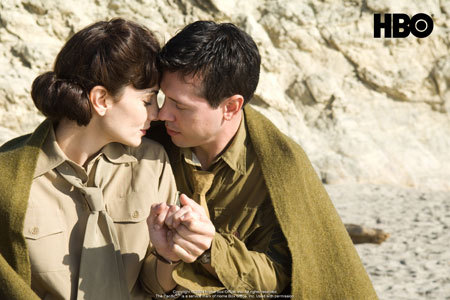
“By telling a story that reflects the thousands of whirlwind wartime romances that happened during World War II. There’s this great desperation element—I might get killed in the next six weeks, we’ve got to get married now—and females really identify with that. They get it.” (Dale Dye in The Atlantic)

He also believes that the love story between the two soldiers John Basilone and Lena Riggi made women like it.

Aha? So it is only the romance that makes women appreciate The Pacific? Could it not be that it has more to do with the fact that there are simply more women in The Pacific than in Band of Brothers?And that there is a whole psychological dimension in The Pacific, with all its tales of post-traumatic stress, that might appeal to women?

I would love some comments. Do women like The Pacific? Do they prefer it to Band of  Brothers? Or did they even like both?

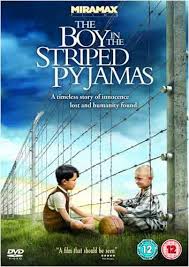
The Boy in the Striped Pyjamas (2008) or An unusual look at the Holocaust

The movie The Boy in the Striped Pyjamas is based on a novel by John Boyne.

The movie tells the story of Bruno, an eight year old boy, whose father is a high ranking Nazi officer newly appointed to be in charge of a concentration camp.

The family leaves Berlin (shot in Budapest, by the way) for a place somewhere in the country, near a concentration camp. The story is purely seen through the eyes of the little boy which creates some very uneasy moments.

I believe that the major theme of this movie is knowing and knowledge. We do know what happened during the third Reich. We know what Endlösung – The Final Solution – means. We know about concentration camps and extermination camps. Watching this movie with all this background information makes for a lot of discomforting moments. All the signs, the chimneys and the smoke, the people in the striped pyjamas… We know what to make of them. Bruno does not. And neither does his mother as it would seem.

The crucial moment is when Bruno meets the boy behind the barbed wire, the boy in the striped pyjamas, Shmuel. An impossible friendship begins. Bruno understands after a while that this boy is a Jew; at the same time he is taught by a fanatic private tutor that Jews are vermin.

Boyne says in an interview that he wanted to tell a different story, add something new to a topic that has been taken up so many times. He is very successful. One thing is for sure, no one who watches The Boy in the Striped Pyjamas is going to forget it easily. The whole way it is told plus the more than atrocious end is by far too unusual to be forgotten.

I am sure it is one of the best movies to teach children the Holocaust.

To be honest, I am still a bit speechless. The whole film and especially the ending are like being kicked in the gut. I am quite awed by the little actors. Asa Butterfield, who plays Bruno, is amazing. This little kid has a way of talking with his eyes that is rarely found in grown up actors. To cut a long story short: Watch it!

See also Children in War Movies: A List

A Story of Naval Combat in the Vein of Master & Commander or Why You Should Watch the TV Series Hornblower (1998-2003)

The British TV series Hornblower or Horatio Hornblower is based on the books by C.S. Forester starring Ioan Gruffudd (King Arthur) as Horatio Hornblower.

It is the movie that is closest to the fabulous Master & Commander that I have seen so far. Sure, there are older movies on the Napoleonic Wars and naval combat but this is my favourite.

I think there are a total of 8 installments. They mostly have two titles, a British and an American one.

The Duel

The Fire Ship

The Duchess and the Devil

The Wrong War

Mutiny

Retribution

Loyalty

Duty

Here are 10 reasons why you should give Hornblower at least a try:

1. If you are looking for movies that resemble Master & Commander

2. If you enjoy naval combat and some gripping rapier fights

3. If you care for a likable character who has to overcome obstacles and wins in the end

4. If you are a fascinated by this period in time and interested in the Napoleonic Wars

5. If you enjoy POW stories (one whole episode shows Hornblower as a captive)

6. If you like a gripping story

7. If two-hour movies are too short for you and you like well made mini series

8. If you are a fan of Ioan Gruffud

9. If you don’t care for too much romance but like a bit on the side  to add another dimension

10. If you like a wide range of fascinating characters, some of which are cunning and evil, others kind and heroic