The Army of Crime aka L’Armée du Crime (2009) The Latest Addition to my Top 10 War Movies or A Gut-wrenching Movie on the French Resistance

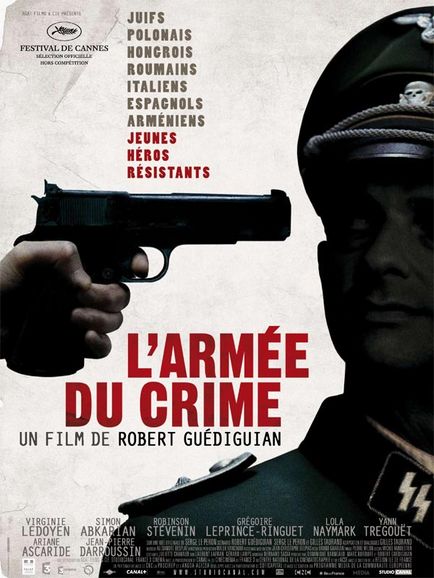
Robert Guédiguian‘s movie L’armée du Crime or The Army of Crime is one of the best war movies I have ever seen. I already said that it entered my Top 10 immediately. The question that remains: which one I am going to kick out? I’ll have to think about this later. For now let me tell you why I think The Army of Crime is such a brilliant piece of filmmaking. Apart from being based on actual events and being historically very accurate it is beautifully filmed. The actors are outstanding. The protagonists are heroical like not many but at the same time the movie doesn’t shy away to point its fingers not only at the Germans but also at the extremely shameful role the French government played during WWII. We had the heroism of the Resistance and Partisan groups on one side and the cowardly collaborators in the government, the police and among normal people on the other side. Shame on all of them. The movie shows all these aspects, nothing is hidden.  This is the third French movie I have seen in a short period, L’armée des ombres aka The Army of Shadows being the first, The Officers’ Ward aka La chambre des officiers the second.  I must say these movies manage something that not many others achieve. They get under your skin. You don’t only watch these movies, you live them. They don’t let you indifferent. Especially not this one.

1943, Paris, the Armenian poet Missak Manouchian (Simon Abkarian) becomes the leader of a special unit of the French Resistance. His people, men and women, are all very young immigrants. They are Hungarian, Polish and Romanian Jews and Spanish, Italian and Armenian Communists. They decide to form a group and fight for France, the country of the Human Rights, to free and to defend her. They are determined and well-organized and soon will be declared enemies number one. The German occupiers and the French police strike back savagely. They hunt them and use every possible way to capture and destroy them, be it bribery, torture or coercion. In the end they are betrayed and all of them are shot.

The movie tells not only the story of the group and their actions as a whole but shows many intimate portraits of all the individual members. I have hardly ever seen a movie displaying so much diversity. This is underlined by a brilliant score with influences of the music of all the different countries that came together in this fight.

The torture scenes are very graphic. We are not spared anything. The most incredible is that with the exception of one person none betrayed the others. Not even under the worst of torture I have ever herad of. While they were operating in the underground most of their families were being deported to camps. Manouchian is an exemplary man. A larger than life character. He does not use arms lightly unlike some of the other reckless young people. He is a poet, an orphan, a gentle man, married to a beautiful French wife, Melinée (Virginie Ledoyen), whom he loves dearly.

I would like to urge each and every reader to watch this movie as my words will never really manage to convey its utter beauty. It is also worth mentioning that we see a lot of Paris.  The Army of Crime is one of those very rare movies that are, simply put, masterpieces in which every element is perfect.

The following people died for France: (AR = found on the Red Poster or Affiche Rouge):
Celestino Alfonso (AR), Spanish, 27
Olga Bancic, Romanian, 31
Joseph Boczov [József Boczor; Wolff Ferenc] (AR), Hungarian, 38
Georges Cloarec, French, 20
Rino Della Negra, Italian, 19
Thomas Elek [Elek Tamás] (AR), Hungarian, 18
Maurice Fingercwajg (AR), Polish, 19
Spartaco Fontano (AR), Italian, 22
Jonas Geduldig, Polish, 26
Emeric Glasz [Békés (Glass) Imre], Hungarian, 42
Léon Goldberg, Polish, 19
Szlama Grzywacz (AR), Polish, 34
Stanislas Kubacki, Polish, 36
Césare Luccarini, Italian, 22
Missak Manouchian (AR), Armenian, 37
Armenak Arpen Manoukian, Armenian, 44
Marcel Rayman (AR), Polish, 21
Roger Rouxel, French, 18
Antoine Salvadori, Italian, 43
Willy Szapiro, Polish, 29
Amédéo Usséglio, Italian, 32
Wolf Wajsbrot (AR), Polish, 18
Robert Witchitz (AR), French, 19

Der Stellvertreter aka Amen (2002) The Disillusioning Reaction of the Catholic Church to the Holocaust

In the beginning of Costa Gavras´ Der Stellvertreter aka Amen we see how a group of children with special needs is transported to an extermination camp and gassed. When this is being found out people are shocked and taken aback and, together with the Catholic Church, they fight these practices that are ultimately stopped.

This noble reaction of the Church is not repeated however when they are asked for assistance in stopping the extermination of Jews. Nor do the alerted Allies help. Der Stellvertreter explores the shameful failure of the Catholic church and the rest of the world.

The SS officer Kurt Gerstein (Ulrich Tukur), head of the Institute of Hygiene, is a chemist and the developer of the lethal gas Zyklone-B. He thinks that this deadly gas is used to free the concentration camps from vermin and must find out that it is actually used for exterminating Jews. He witnesses this with his own eyes and his outrage and revulsion are so intense that he decides to alarm the Catholic Church. Only one young priest, whose family is of great influence in the Vatican, Riccardo Fontana (Mathieu Kassovitz), feels the urge to support Gerstein, travels to the Vatican and informs the Pope. To no avail. The Church won’t act.

The Church fears many things. They are afraid that communism might spread and are grateful to the Nazis who stopped it. They are afraid that they might not be spared by the Nazis if they oppose too openly. And, as the movie seems to say, they ultimately don’t care too much about the Jews.

Gerstein and Fontana will go on fighting and trying to inform people, to make at least the Allies act. The Allies however don’t want to act as they don’t want to negotiate with criminals. Every time Gerstein and Fontana inform someone about the extent of the atrocities the numbers have risen. From an initial hundred thousand they are soon in the millions. These numbers are symbolized in the numerous takes of riding trains we see during the movie.

As an ultimate sacrifice and because he thinks it is his Christian duty the young priest joins a transport of Italian Jews to one of the concentrations camps.

Kurt Gerstein is a historical figure. After the war all the important figures of Nazi Germany were incarcerate. Gerstein, facing trial and before killing himself, writes a report on everything he has seen. Years later he is found not guilty and rehabilitated.

As interesting as the theme of this movie is I did not find it completely compelling. Maybe because it is based on a theater play (Rolf Hochhut’s Der Stellvertreter aka The Deputy)? I don’t know. I think you will have to find out for yourself. 4/5 stars but still valuable.

Hitler – The Rise of Evil (2003) Hitler´s Childhood, Youth and Early Years

The only thing necessary

for evil to flourish

is for good men

to do nothing.  (Edmund Burke)

Hitler – The Rise of Evil follows Hitler´s early years. First his childhood with an abusive father, then the pursuit of his dream to become a great artist which lack of talent prevented. His participation in WWI,  his rise through the ranks of the German Worker´s Party, his imprisonment that gave him time to write Mein Kampf. Even though this movie ends around the year 1934 with Hitler becoming Reich´s President, I think it is fair to include it on a war movie blog as it permits to see what happened prior to WWII and how the Jews were persecuted long before the war

The Scottish actor Robert Carlyle gives a stunning performance starring as Hitler. The madness of Hitler is creepy and palpable. However exactly this has been criticized. When you watch this movie you can´t help thinking all the time: how did he get away with it? He was so obviously deranged, mad and psychologically disturbed that no one should have been tempted to follow him. I think that in showing Hitler exactly like this, this movie contributes to shed another light on him. Sure, we know he was sick but still we tend to see him as a deranged dictator. I would say it is high time to look at him as some sort of head of a sect. He should be paralleled with people like Charles Manson and Jim Jones. The same psychological dynamics that are at work in people who follow cult leaders were also present in many Germans at the time.

The movie also manages to show how many people just didn´t react or looked the other way. There is only one journalist (played by Matthew Modine) who points out how dangerous Hitler is. The Rise of Evil has a close look at Hitler´s relationship with women (his niece and Eva Braun) where his full-blown madness is maybe as evident as in his hatred of the Jews. A great part of the movie focuses on the American/German couple Hanfstaengel. Their importance seems not historically accurate and it might very well be that their role had been extended for the sake of US viewers. I thought it interesting to see how Helene Hanfstaengel (Julianna Margulies) who was against Hitler at the beginning, all of a sudden changed her mind and became one of his most fervent supporters. Many women fell for him, as odd as this may seem. The role played by Ernst Röhm (Peter Stormare) is also explored with great detail as is the person of Hindenburg (Peter O’ Toole)

Nobody should compare this film to Der Untergang aka The Downfall as hardly any movie is as good as that but it is thought-provoking, interesting and, as already said, Carlyle is amazingly good.

Danger UXB (1979) A Clever British TV Series about a Bomb Squad During the Blitz

I would say that this British TV series is one of the most realistic stories ever told about London during the Blitz and the dangerous duty of defusing the numerous unexploded bombs that hit the country. Danger UXB focuses on a young lieutenant, Brian Ash (Anthony Andrews), appointed to a bomb squad. His squad defuses all sorts of unexploded German bombs. This is highly stressful and very difficult. There are so many different types of bombs with different types of fuses. Magnetic, movement detectors, chemical reaction, clock work and time delay fuses. The bombs are found in many different places such as  schools, gardens, back yards, living rooms,  a night club, a factory  which gives ample opportunity to tell side stories and show the lives of ordinary people during this time. It is hard to imagine what it must have been like to be bombed every single night. The series manages to give a very good feel for the danger of this line of work.  I would say Danger UXB provides a rare combination of instruction and entertainment, combining historical accuracy with tales of everyday lives and the story of one young officer, his work , his dealings with fellow officers and commanders and  his love life. British TV is a great source for realistic historical series and movies. I haven’t seen Piece of Cake yet but it is sitting here, waiting to be watched. Danger UXB is far less known. I highly recommend it. I think it is also interesting to compare it to the ubiquitous The Hurt Locker (see my post on The Hurt Locker) and see the difference between a bomb squad now and then.

I attached a video for you, where you can see that each episode initiates with original footage to enhance accuracy. Unfortunately this video has an addition to it but it is the best I could come up with. I couldn’t find any trailer only some fan videos but they had insufferable music.

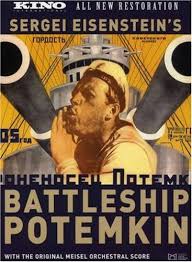
Sergei Eisenstein’s Battleship Potemkin aka Bronenosets Potyomkin (1925): A Painful Movie Experience

Eisenstein’s Battleship Potemkin is one of the great cinema classics and the first time a movie was dedicated to a Revolutionary act. It tells the story of a mutiny that took place in 1905 and was followed by a street massacre. The crew of the Battleship rebelled against their officers.

Some of the scenes, like the one posted below, dubbed “Odessa Steps”, have written film history.

Be it as it may, I suffered all through the viewing of this film. I found it agonizingly boring. Maybe I am just not a silent movie person although I seem to remember I have seen a few that I liked.

Still, I quite like the Odessa steps scene but the parts on the ship with the long takes on machines and guns are excruciating.

We have to bear in mind that this movie is also an eloquent piece of propaganda.