Das Boot (1985) TV Version

Das Boot

I love this movie. I can’t believe I didn’t rewatch it earlier. When I started this blog I wrote a Top 10 favourite war movies list and Wolfgang Petersen’s Das Boot was one of them. I’m glad to say that after rewatching it, it’s still among my Top 10, even among my Top 3. I don’t think war movies get any better than this. Or, I’d even say, movies don’t get any better than this. I’ve watched the longer TV version. I’ve not seen the Director’s Cut, so it’s hard to compare but I really love the slow build-up of this version.

Das Boot starts in 1941, in La Rochelle. We see a U-Boot crew leave the harbour. They are cheering, singing and looking forward to their mission. The crew members are mostly young, in their late teens and early twenties, only their captain is thirty years old. This time, they have a war correspondent on board, Lt Werner (played by German singer/songwriter Herbert Grönemeyer). He’s a lieutenant but inexperienced in combat, as it seems, and has never been on a U-Boot. We see a lot of the story through his eyes, and, as usual, when we have a young journalist/writer character like this among the crew, the movie is to some extent about the loss of innocence, the futility of war etc. But that’s the topic of many war movies, what makes Das Boot so outstanding is how carefully it’s been filmed, how accurate it is. After watching this, without ever having been on a U-Boot, you’ll have a good idea of how claustrophobic this must have been and of  how helpless the crew must have felt at times.

The first half of the TV series doesn’t do much more than introduce the characters and the daily activities on a U-Boot. Most of the characters are complex and likable and not exactly Nazis. The U-Boot gets in the line of fire of a destroyer but other than that it’s relatively quiet. The worst thing that happens is a three-week storm. And that is awful. Most of the time the U-Boot doesn’t dive and in a storm it’s even shaken more badly than many other ships. The captain lets them dive occasionally for an hour or two, just to give the men some rest.

The second part of the series, is much more action packed. They encounter destroyers and are shot at by planes. When they think they can finally return to La Rochelle after a few weeks, they are sent to Vigo in Spain, to resupply, and from there to Italy. The most exciting part is when they have to pass the straits of Gibraltar, get hit and sink rapidly. The fight for the boat and, ultimately, for their lives, is one of the most gripping scenes in war movie history. But as suspenseful as this is, there’s another scene I like even better. It takes place just before they leave Vigo. The captain and his officers are invited to dine with the officers stationed in Vigo. Spain is neutral territory and those stationed there have probably not seen any combat. They are well-groomed, well-fed and beyond clueless when it comes to the battle in the Atlantic or what the crew has gone through. Without ever being openly aggressive or rebellious, the crew sabotages the nice little dinner event by just being themselves— gruff looking, outspoken and past niceties. I loved how this showed the hypocrisy of those officers who were true to the regime but not willing to actually fight for their country.

Most of the action takes place inside but we occasionally see the U-Boot from outside, see how it silently glides through the waters, like a predator. Those shots are dark grey, almost like black and white shots, and I couldn’t help thinking of a wolf, before I remembered that the U-Boots were called grey wolves. Showing this like that is such a minimalistic approach but it works well. Even if you don’t know, your subconscious is going to register it. The music underlines the different elements and changes accordingly.

Sadistic officers abound in many war movies, luckily Das Boot is an exception. The movie gives us one of the strongest positive commanders I’ve ever seen in a war movie. I couldn’t think of a better actor than Jürgen Prochnow for this role.

According to a text following the opening credits, only 1 out of 4 U-Boot crew members survived, which means over 30,000 died. That’s a huge loss of lives. But not only are they in constant danger but they also have to put up with a lot of other dificult things: confinement, lack of space, air and fresh food. No wonder the men look far less cheerful and aged when they finally return to La Rochelle.

If you haven’t watched Das Boot yet, you should do so as soon as possible. It’s one of the very best (war) movies ever made.

For those interested: I’ve attached a music videos of Herbert Grönemeyer under the trailer. He happens to be one of my favourite German singers. His lyrics are simply brilliant.
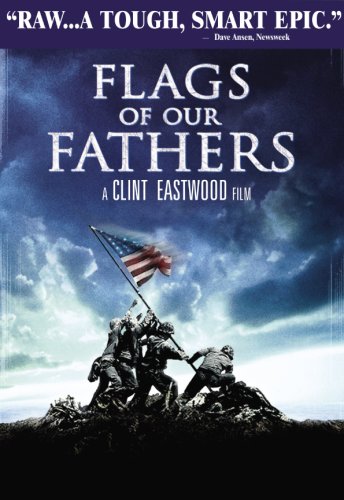
Flags of Our Fathers (2006)

Flags of Our Fathers

 “The right picture can win or lose a war.”

I remember watching Clint Eastwood’s Flags of Our Fathers shortly after it was in the cinemas and feeling less than enthusiastic about it. I’d been watching my way through the best infantry combat movies at the time, so, obviously, Flags of Our Fathers fell short. After re-watching it yesterday I must say, it’s not bad at all. Quite the contrary. Sure, it has some corny Hollywood moments, but overall it’s a very interesting movie about topics that are still relevant today: the power of images and the making of heroes.

Flags of our Fathers tells the story of the iconic picture that rekindled the American war effort. Looking at the photo below I would say it’s extremely powerful. I’m not surprised it had such an effect.

APTOPIX OBIT ROSENTHAL

The movie starts with two elderly men reminiscing and telling their story to the son of one of them. The son knows his father took part in the battle of Iwo Jima and that he’s on the famous picture but he doesn’t know much more. His father never spoke about the war. From this initial moment the movie is composed mostly of flash back sections, some of which showing what happened on Iwo Jima, some telling about what came after the picture was shot.

Iwo Jima – or Sulfur Island – was a strategic point. Taking the hill meant that the US might after all have a chance to win the war. When the troops land, the island looks bleak, dark, forlorn and empty. It’s quite a creepy moment, which is enhanced through a change in point of view. We first see the troops land and slowly walk towards the hill, scanning the landscape and then we get the point of view of the hidden Japanese who observe the troops from their fox holes. Needless to say that this first wave of US soldiers is quickly heavily decimated. Still, many make it to the top and that’s when they plant the flag. A senior officer later demands this flag and the commanding officer decides to exchange it and to let him have another one. Both flag raisings are photographed but it’s the second, which is the better picture, that makes it into the newspapers.

Three of the men who raise the flag survive. However, inadvertently, one of the first six is named as the sixth of the second group, which will cause a lot of heartbreak.

The three survivors are sent back to the States where they are touring the country and trying to convince people to help the war effort and buy bonds.

The three men who haven’t done anything more heroic than holding a heavy pole, feel uncomfortable about being called heroes. One of them, an American Indian, is especially uncomfortable. He feels like a cheat. Not only because he doesn’t feel heroic but because they were not even part of the initial flag raising. It feels like he’s deceiving people. The mix up of the sixth soldier makes it even worse.

The movie is sleek and visually compelling. The combat scenes on the island are shot in gritty almost black and white pictures, which form a contrast to the colorful home front scenes.

The actors, notably Adam Beach and Ryan Philippe, are very good. The score is discreet and well-chosen. It stays mostly in the background.

I thought Flags of Our Fathers was really watchable. More than that actually. It’s very good. It shouldn’t be seen as a combat movie but more as a movie about the impact of pictures, an exploration of the true nature of heroism and the way society treats heroes when they aren’t needed anymore. It was sobering to see their treatment. At no point were they seen as soldiers and men but merely as a possibility for propaganda. This became even clearer after the war when people lost all interest in them.

Agnieszka Holland’s In Darkness (2011) A WWII True Story

In Darkness

Agnieszka Holland’s movie In Darkness is a Polish/German/Canandian co-production based on a true story.

Leopold Socha (Robert Wieckiewicz) is a sewer worker and petty thief, living in Lvov, a Nazi occupied city in Poland.  One day he meets a group of Jews trying to escape the liquidation of the ghetto. After lengthy discussions he agrees to help them hide in the labyrinthine sewers under the city. Many of the Jews do not trust him, knowing well that the Nazis’ pay money for every Jew and that many Poles don’t like Jews either. Socha is rather poor and he and his family are struggling. Helping is not an act of altruism but a great opportunity to make money, as one of the Jews is very rich.

While Socha does a great job at providing them with food and helping them to change hiding places, when one gets too dangerous, he has not feelings or compassion for them at first. But over the months – the small group has to stay in hiding for 14 months – he gets to know them and admires their courage and determination. At the end, although they have run out of money, he still helps them, and risks his life and the lives of his wife and daughter.

In Darkness is a very moving film, based on an amazing story of resilience and courage. Staying in the dark and the stink, surrounded by rats, in close quarters, is very hard to imagine. Not all of those who are in the sewers in the beginning make it until the end. Quite a few, escape, some prefer to be sent to a camp.

When everything goes fine, the situation is bearable but hunger, illness, boredom and one woman’s pregnancy turn it into a nightmare at times.

On my DVD is a documentary called In Light, in which the film director Agnieszka Holland and Krystyna Chiger, one of the children who spent 14 months in the sewer, talk together about the film. When  Agnieszka Holland started filming, they had no idea that here still was a survivor although Krystyna Chiger had published her memoir The Girl in the Green Sweater shortly before that. A streak of luck brought them together. It was great to hear Krystyna’s impressions of the film. According to her, the movie manages to show exactly how it was. Everything, down to the smallest detail is correct.

Leopold Socha was one of many Poles who risked everything to hide Jews. It’s important to tell these stories as well.

There were quite a few well-known German actors among the cast – Benno Fürmann, Maria Schrader and Herbert Knaup – who were all good, but none of them surpassed Robert Wieckiewicz in the role of  Leopold Socha.

In Darkness is an excellent movie based on a true story that had to be told. Highly recommended.


Miklós Jancsó’s The Round-Up – Szegénylegények (1966)

The Round-Up

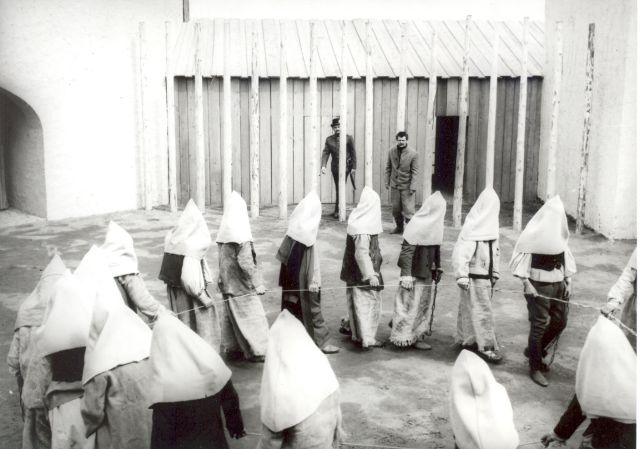
I suppose when you’ve seen quite a lot of the well-known prisoner of war films and are fond of the genre, you’ll come across Miklós Jancsó’s The Round-Up aka Szegénylegények sooner or later. Not only is it an unusual example of a POW movie, but it’s considered to be a masterpiece of European filmmaking and was highly influential.

Miklós Jancsó is a Hungarian film maker. He started out with documentaries before he moved on to movies. He’s made a few famous films – The Red and the White – My Way Home and many others. The Round-Up was the movie that made him famous and is still considered to be his most important film.

The Round-Up is set in a prison camp, on some God-forsaken stretch of land on the Hungarian Plain (Puszta). It’s the mid 19th century and the Austrian hegemony has just been re-established after the unsuccessful revolution of 1848. The men who are held in this prison camp are suspected to be followers of the leader of the revolution Lajos Kossuth. There is still a lot of guerilla activity going on and the Austrians, helped by their Hungarian counterparts, try to find out who are the guerilla leaders. Most of them are suspected to be among the prisoners and the guards use perfidious and sadistic techniques to find out who they are. 

What we see applied in this film is psychological torture. People are promised not to be executed if they can find others who killed more people than they did. Or the guards pretend that a guerilla leader will be pardoned which makes his followers cheer. Of course they have been set up and that was a means to find out who they are.

Humiliation is part of the tactics used. We see how one officer is stripped of his rank, how the guards rip all the insignia from his uniform and while they do not harm him, it feels extremely violent. We later realize that this was foreshadowing as other suspects undergo a fate that’s similar but even worse. One girl is stripped and whipped until she dies. Watching the whipping of the girl triggers a flood of suicides. Later men are stripped too.

Torture is always humiliating but this subtle use of psychological torture is, although less violent, just as effective in that regard.

I have to be honest, I personally didn’t like this film, although it has a lot of poignant scenes, which I’m not likely to forget, but overall this isn’t my type of movie. It’s visually expressive but there isn’t much plot and hardly any dialogue. I don’t need action or plot but I like more atmosphere and dialogue. The Round-Up is all about forms, shapes, space and minimal movement. Plus it’s set in the type of flat landscape I’m really not keen on. That doesn’t mean I didn’t appreciate the film, I just couldn’t relate to it much. But it’s an important movie if you are either a cinephile or a war movie completist. I’ll watch The Red and the White and My Way Home next.

You can watch the whole movie on YouTube

https://www.youtube.com/watch?v=96osyWNblwU