10 German War Movies You Must See Before You Die

In the last years Germany has made quite a few very good war movies but there are also some older ones that have stood the test of time. I am sure I have forgotten some and left out many that are co-productions with the exception of Joyeux Noël aka Merry Christmas because it is one of my Top 10. I will very probably mention it again when I will make a post on 10 French war movies you must see before you die.

Let´s stick to Germany for the time being.

Die Brücke aka The Bridge (1959): WWII, Germany. One of the best anti-war films ever. Shows how senseless some orders are. Young people fight for a bridge although the war can´t be won anymore. It is one of the movies on my list Children in War Movies.

Hunde, wollt ihr ewig leben aka Dogs, do you want to live forever – Stalingrad (1959): WWII, Russia. A German classic. A grim look at the battle in Stalingrad.

Das Boot (1981): THE U-Boot movie. Conveys brilliantly what it is like to be helpless under water. Claustrophobic feel. Superb acting. Marvellous cast. Especially noteworthy the singer Herbert Grönemeyer.

Stalingrad (1993): WWII, grim infantry combat. German POV. One of the best war movies  ever, one of my Top 10 as well. The setting, the character portraits, the acting, the combat, the snow, the cold, the despair. A fabulous movie that gives an insight in one of the worst chapters of WWII. Another marvellous cast. Thomas Kretschmann (King Kong, Resident Evil, The Downfall, The Young Victoria) is in it. He is one of those German actors that are known far beyond Germany and Europe. (see my post on Stalingrad)

NaPolA aka Before the Fall (2004): WWII, Germany. Interesting look at the Hitler Youth. How they recruited their elite, how they brainwashed them. Poisonous Pedagogy. See my review for more details. This movie is also on the Children in War Movies list.

Der Untergang aka The Downfall (2004): WWII, Berlin. The final days of Hitler. Astonishing acting from the very great Bruno Ganz. A fascinating portrait. Eerie. Creepy.  An outstanding movie and a must see even for those who don’t watch war movies. (see my post on The Downfall)

Joyeux Noël aka Merry Christmas (2005): WWI, France. Especially noteworthy as it is about WWI. The movie depicts the so-called “Little peace”. It is Christmas and something strange is happening. The war stands still. The enemy soldiers prefer football over fighting and get to know and like each other. Based on a true story. You get a good feel for the differences of the trenches and the characteristics of the parties involved.

Sophie Scholl – Die letzten Tage aka Sophie Scholl (2005): WWII, Germany. German Resistance. One of the leaders of The White Rose, Sophie Scholl´s final days. I have hardly ever seen a movie like this. After watching it I did solemnly swear to become a better person (I am not too successful yet. It is an ongoing process. A work in progress). No, honestly, this woman or girl´s guts… So much selfless idealism and courage. I was awed.

Anonyma – Eine Frau n Berlin aka Anonyma – The Downfall of Berlin (2008) : WWII, Berlin. One of the movies I reviewed recently. I included it as it tackles a lesser known and very painful subject. The mass rape of German women by the Red Army. See my post of Anonyma.

Der rote Baron aka The Red Baron (2008): WWI, Germany. The romanticized story of Baron von Richthofen the famous German fighter pilot. Beautifully filmed, good-looking cast, very intense air combat. See my post of the Red Baron.

Any movies you would add?

As I think Sophie Scholl is not known enough I added the trailer for you.

La vita è bella aka Life is Beautiful (1997) A Thought-Provoking Italian Holocaust Movie

, w

La vita è bella is a very unusual movie that you will hardly ever forget should you watch it. It is touching, at times funny, tragic and sentimental. It shows one man’s attempt to protect his child from the horrors of the concentration camp and how he fails in the end. It is one of the movies on my Children in War Movies List.

Roberto Benigni, the Italian main actor, writer  and director of La vita è bella is mainly known as a comedian. People were quite surprised when they heard he had done a movie on the Holocaust. I remember that I had mixed feelings but was really surprised how well this combination works. Other critics however felt offended as they stated it was in poor taste to attempt to combine a comedy with the topic of the Holocaust. But the comedy pretty much stops when the war begins. The movie has really two parts that are strikingly different which was obviously wanted. The beautiful before and the horrible after.

The Jewish man Guido Orefice (Roberto Benigni) is not a good-looking guy. He is not even very intelligent. He is clumsy and silly but also very funny and charming and has an eye for poetical and beautiful things. This is how he wins the heart of the attractive Dora even though she is already engaged to a future fascist leader.

The second part starts a few years after their marriage. They have a little boy named Guisoué. Anti-Jewish laws have been implemented in Italy and Guido tries to hide their meaning from his son by turning them into a game. When they know they will be deported, Dora, even though she is not Jewish, accompanies them to the concentration camp. Once arrived Guido pretends that this is all a game, some sort of summer camp for children and grown-ups alike. He makes his son believe that they have to follow all the orders strictly if they want to win.

I must admit that I did not totally approve of Benigni’s approach, but it is not a movie that is easily forgotten. And it is thought-provoking and will give ample material for discussion of various questions. Are we allowed to tell the Holocaust through comedy? Should a movie about the Holocaust be this sentimental? Wouldn’t it be better to tell it in a more sober manner? La vita è bella is also problematic when it comes to the historical facts. Children were not kept alive in the camps. Still the first part is a touching and funny story of an impossible courtship while the second is the story of a fathers attempt at keeping the horror at bay.

Did you see it? Did it work for you? And if you haven’t, would you want to watch it? Do you mind a Holocaust comedy?


Danger UXB (1979) A Clever British TV Series about a Bomb Squad During the Blitz

I would say that this British TV series is one of the most realistic stories ever told about London during the Blitz and the dangerous duty of defusing the numerous unexploded bombs that hit the country. Danger UXB focuses on a young lieutenant, Brian Ash (Anthony Andrews), appointed to a bomb squad. His squad defuses all sorts of unexploded German bombs. This is highly stressful and very difficult. There are so many different types of bombs with different types of fuses. Magnetic, movement detectors, chemical reaction, clock work and time delay fuses. The bombs are found in many different places such as  schools, gardens, back yards, living rooms,  a night club, a factory  which gives ample opportunity to tell side stories and show the lives of ordinary people during this time. It is hard to imagine what it must have been like to be bombed every single night. The series manages to give a very good feel for the danger of this line of work.  I would say Danger UXB provides a rare combination of instruction and entertainment, combining historical accuracy with tales of everyday lives and the story of one young officer, his work , his dealings with fellow officers and commanders and  his love life. British TV is a great source for realistic historical series and movies. I haven’t seen Piece of Cake yet but it is sitting here, waiting to be watched. Danger UXB is far less known. I highly recommend it. I think it is also interesting to compare it to the ubiquitous The Hurt Locker (see my post on The Hurt Locker) and see the difference between a bomb squad now and then.

I attached a video for you, where you can see that each episode initiates with original footage to enhance accuracy. Unfortunately this video has an addition to it but it is the best I could come up with. I couldn’t find any trailer only some fan videos but they had insufferable music.

Costa-Gavras’ Music Box (1989) A Court Room Drama About War Criminals

Music Box is not a war movie in the strict sense of the term, especially not since it takes place some 40 years after the war. But it is about what happened to war criminals after the war. The one or the other is still caught today. Many tried to hide in distant countries. Some live in South America but there are certainly also a lot in the US. Since I want to watch Der Stellvertreter aka Amen by Costa-Gavras, I thought it might be interesting to re-watch this one before. I remembered that it moved me quite a bit when I saw it for the first time. I found it totally gripping. As much of the suspense comes from the question whether or not the accused committed the crimes I could concentrate on other elements this time.

Just imagine for one second, someone told you, your mother, or your father was a war criminal. He is said to have left the country shortly after the war and gone to the US where he led an exemplary life as a devoted father, able worker and much liked colleague. Imagine the two of you had a very close relationship. You love the stories your father tells you about his childhood and his youth, the horrors of the war and how he managed to flee to a more welcoming country. Your son adores him, your in-laws respect him. But then, one day, the US government accuses him of being a monster and wants to extradite him to Hungary where he would be judged. That is the story of Music Box. Ann Talbot’s (Jessica Lange) father, Viktor Laszlo, a Hungarian immigrant is accused of having committed war crimes. Ann is a successful lawyer and decides, after some initial reluctance, to defend her father. She doesn’t doubt for one second that he is innocent and soon she is able to prove that there have been wrong accusations before, that the Communist countries often try to get at those who fled from them. She is outraged by the injustice that is done to her father and equally shocked by the crimes, the man who is called Mischka, has committed. Torture, executions and rape. But what is the worst he is accused of is the fact that he showed no mercy, compassion or any other signs of empathy. Mischka enjoyed what he did. Much of it took place on the banks of the Danube in Budapest, near the famous Chain Bridge. One of the last parts of this gripping court-room drama takes place in Budapest. A nice addition to the movie. Budapest is a town I am particularly fond of but when I had seen the movie for the first time, I hadn’t been there yet. I didn’t even remember that part of it was filmed there.

Jessica Lange, Armin Mueller-Stahl and Frederic Forrest, the main actors are fantastic. Armin Mueller-Stahl is one of the very great German actors. I have often problems when actors fake an accent but he does it well.

For one reason or the other, I always compare Music Box to Sophie’s Choice. I find them both equally convincing from a psychlogical point of view. Both have outstanding female actresses in main roles. And they both have this typical 80ies feel.

I was wondering how I would rate this movie. It is interesting and gripping, psychlogically accurate but doesn’t deserve 5/5. It is somewhere between 4 and 4.5 because it is a tad too sentimental.

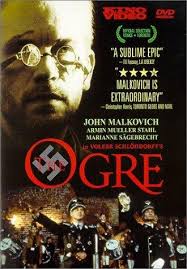
The Ogre aka Der Unhold (1996) or Nazism, Symbolism and the Erlking

Volker Schlöndorff’s The Ogre aka Der Unhold (France/Germany/UK) is based on Michel Tournier’s novel Le Roi des Aulnes aka The Ogre. The Ogre is a highly symbolical, original and complex  movie that attempts nothing less than to explore Nazi symbolism and ideology, German culture and mythology by telling the incredible story of Abel Tiffauges, a man who loves children and animals and who makes himself believe he is more than just human. The movie is filmed in English, French and German.

Plot

Abel Tiffauge’s story has five very distinct parts. Part I. Childhood. The French boy Abel grows up in a Catholic private school for boys. He is the outsider, the odd one, the one others pick on, the one the priests punish whenever someone has done something. Especially a very fat boy exploits Abel whenever possible. But he is also his only friend. When Abel is wronged again he wishes a catastrophe upon everybody. And it happens. From now on he believes he is invincible and powerful. Part II. Grown-up. Abel is still odd and a loner but he is also an auto mechanic with a flourishing business. Abel is also an amateur photographer and likes to take pictures of kids. There is nothing he loves more than kids. This very innocent fondness is mistaken for child molesting. Instead of being sent to prison, the falsely accused is sent to war. Part III. POW. Abel is captured together with his officers and sent to a German camp, somewhere near the Polish (?) border. During the day when everybody works he sneaks off to an abandoned hut and befriends a moose. One day he meets Goering’s forester. Part IV. Goering. If Goering was anything like the Goering portrayed in this part, then he was one of the most revolting beings to have ever walked this Earth. Abel is to help on his hunting lodge and gets a close look at the way the Nazis and their friends spend their leisure time. Drinking, eating, hunting. Very vulgar. Part V. The Erlking. Abel is sent to Kaltenborn Castle an elite training camp for German boys. He is happy like never before and loves to be able to take care of these boys but he also takes an active part in their training. Soon he starts to collect the boys from the neighbourhood and the people who are afraid of him call him the ogre. He doesn’t realize that he is doing wrong. When the Russians approach and people from concentrations camps are liberated, he starts to understand what he has been part of. He tries to help a Jewish boy and almost gets killed.

Meaning

So much for the content of The Ogre. But that is only one part. The movie shows us in stunning pictures what it must have been like to face Nazi ideology. The power of the imagines they created by using potent symbols is amazing. The visualization of this ideology is fantastic. Just take a look at the trailer and you see some of it. The boys standing in the form of a giant Swastika holding burning torches in the night. But then there is also the undercurrent of German culture, of everything that was good about Germany and was perverted by the Nazis. The love of the forest, love of animals, children, poetry.  Goethe’s famous ballad The Erlking is quoted and put into pictures in a very spooky way. Without knowing this poem a great part of the movie’s meaning stays hidden.

Who’s riding so late through th’ endless wild?
The father ‘t is with his infant child;
He thinks the boy ‘s well off in his arm,
He grasps him tightly, he keeps him warm.

My son, say why are you hiding your face ?
Oh father, the Erlking ‘s coming apace,
The Erlking ‘s here with his train and crown!
My son, the fog moves up and down. –

Be good, my child, come, go with me!
I know nice games, will play them with thee,
And flowers thou ‘It find near by where
I live, pretty dress my mother will give.”

Dear father, oh father, and do you not hear
What th’ Erlking whispers so close to my ear?
Be quiet, do be quiet, my son,
Through leaves the wind is rustling anon.

Do come, my darling, oh come with me!
Good care my daughters will take of thee,
My daughters will dance about thee in a ring,
Will rock thee to sleep and will prettily sing.”

Dear father, oh father, and do you not see
The Erlking’s daughters so near to me?
My son, my son, no one ‘s in our way,
The willows are looking unusually gray.

I love thee, thy beauty I covet and choose,
Be willing, my darling, or force I shall use!
“Dear father, oh father, he seizes my arm!
The Erlking, father, has done me harm.

The father shudders, he darts through the wild;
With agony fill him the groans of his child.
He reached his farm with fear and dread;
The infant son in his arms was dead.

The Cast

John Malkovich as Abel Tiffauges is astonishing. I think it is one of his best roles. He is such a weird-looking actor and that is perfect for this role. I particularly like the three German actors Heino Ferch, Armin Müller-Stahl and Gottfried John. But everybody else, especially those many little boys and girls, are very convincing.

The Director

Volker Schlöndorff can look back on a career with many an important movie. He is not just any director but one of the very great. He has done the war movies The Tin Drum and The Ninth Day and the movies Swann in Love, The Handmaid’s Tale and Ulzhan.

The Score

Michael Nyman is one of my favourite composers. He is foremost famous for the scores he wrote for Peter Greenaway and Jane Campion. This one here is OK but not as outstanding as his other work like Draughtman’s contract, Gattaca and The Piano to name but a few.

For me this is a 5/5 star movie. It has incredible pictures, is dense and complex and invites you to rethink Nazi ideology and symbolism like not many others. It is better than the Boy in the Striped Pyjamas that is for sure. But not as good as Pan’s Labyrinth.

Other war movies with children as main characters can be found on my list  Children in War Movies.