Children in War Movies: A List

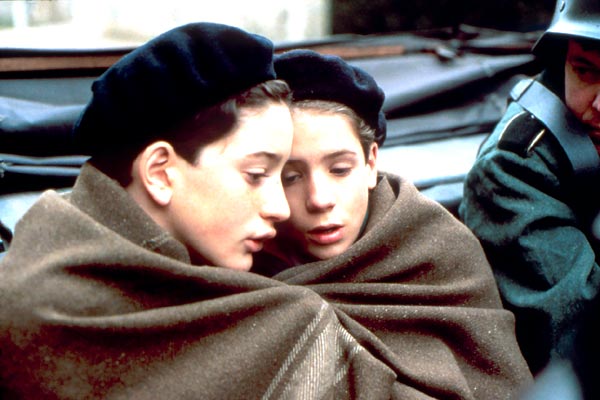
In this post I would like to focus on war  movies in which children have leading roles and are not just supporting actors like in The Hurt Locker to name but one example.

There are many movies whose sole focus are children. They come from different countries, show different conflicts and times but they have one thing in common: they are all good, very good or outstanding. This is quite remarkable. It is as if those film directors who aim for entertainment only would shy away from showing children in war movies. All the movies listed below are very different in tone. Some are light and almost playful, like Hope and Glory, some are depressing and raw like Come and See, others have the quality of a fairytale like Pan´s Labyrinth.

I am sure my list is not exhaustive. If you know of any others, let me know. I will try and review most of them in later posts,  like I already did with Hope and Glory (see post), Welcome to Sarajevo (link to post), The Children of Huang Shi (see post) and Savior (see post). I am stating the name and the year and country in brackets. The conflict and where the war takes place follow behind. I did include a few movies with teenagers in it like The Bridge or Napola, but most of the others focus on much smaller children. I did also  include Savior as the newborn is central to the story.

I am sure you will discover many you did not know yet as I did.

The Drum (GB, 1938): India

Mrs Miniver (US 1942): WWII, British Homefront

Since You Went Away (US, 1944): WWII, American Homefront (here is my review)

Roma, Città Aperta aka Rome, Open City (Italy, 1945): WWII, Italy

Kim (US, 1950): India

Forbidden Games aka Jeux interdits (1952, France): WWII, France

The Bridge aka Die Brücke (1959, Germany): WWII, Germany

Two Women aka La ciociara (1960, Italy/France): WWII, Italy

Ivan’s Childhood aka Ivanovo detstvo (1962, Soviet Union): WWII, Russia

Hornet´s Nest (1970, USA): WWII, Italy

Lacombe Lucien (1974, France): WWII, France

The Tin Drum aka Die Blechtrommel (Germany, 1979): WWII, Germany

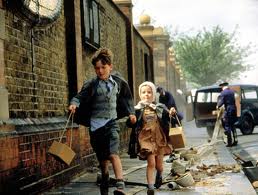
Hope and Glory (1987, UK): WWII, Blitz  (Here is my review)

Empire of the Sun (1987, USA) : Chinese-Japanese War WWII

Au-revoir les enfants aka Goodbye, Children (1987, France/Germany): WWII, Holocaust,France

Grave of the Fireflies aka Hotaru no haka (1988, Japan): WWII, Japan. Anime. (See my post)

Europa, Europa aka Hitlerjunge Salomon (1990 Germany/France/Poland): WWII, Germany (See my review)

Come and See aka Idi i smotri(1985, Soviet Union): WWII, Byelorussia

The Ogre aka Der Unhold (1996, France/Germany/UK): WWII, Nazi Germany

Welcome to Sarajevo (1997, USA) : Bosnia

Life is beautiful aka La vita è bella (1997, Italy): WWII, Holocaust (see post on La vita è bella)

Savior (1998, USA ): Bosnia

Silent Night (2002, USA): WWII, Germany (see my post on Silent Night)

Innocent Voices aka Voces inocentes (2004, Mexico/USA/Puerto Rico): El Salvador (see my post on Innocent Voices)

Turtles can fly aka Lakposhtha parvaz mikonand (2004, Iran/France/Iraq): Iraq

Before the Fall aka Napola (2004, Germany): WWII, Germany (see my review of NaPola)

Pan´s Labyrinth aka El laberinto del fauno (2006, Spain): WWII Franco´s Spain

Under the Bombs aka Sous les Bombes (2007, France/Lebanon): 2006, Lebanon (see my review of Under the Bombs)

Miracle at St. Anna (2008, US): WWII, Italy (here is my review)

The Boy in the Striped Pyjamas (2008, UK/USA): WWII, Holocaust (see my review)

Escape from Huang Shi aka The Children of Huang Shi (2008, Australia, China, Germany, USA): Japanese occupation of China

Winter in Wartime aka Oorlogswinter (2008, Netherlans, Belgium): WWII, occupied Hollad in Winter, 1945 (here is the link to my post)

The Fortress of War aka Brestskaya krepost (2010, Russia): WWII, Russia 1941. Germans attack the Brest Fortress (here is the link to my post).

The Round-Up – La Rafle (2010, FR/GE/HU): WWII, Paris, the round-up of 13000 Jews in the Vel d’Hiv (here is my review)

This list is being updated regularly.
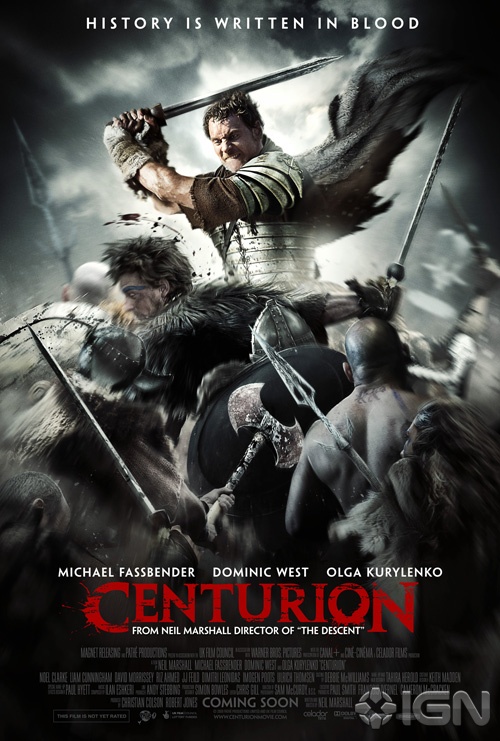
Centurion (2010): A little bit of Gladiator, King Arthur and 300

When I started this blog I wanted to stick to war movies in the strict sense of the term only but now I feel I am in the mood for more liberties. A few months back I would not have included Centurion but now I do. I would not have mentioned Gladiator, King Arthur or 300 either. (If I did, King Arthur would be high up in my Top 10, probaly even making Black Hawk Down step down.)

Be it as it may, to compare Centurion (a British movie by the way) to those above mentioned movies is very unfortunate for it because it is not up to the comparison, I’m afraid. Nevertheless it is  entertaining. However, compared to the three others, Centurion is super gory. And there are a lot of very combative warrior women in it. By the way, Dominic West, from The Wire,  is in this one too but he is not the main character. He stars as General Vilnius. Michael Fassbender has the leading role as the Centurion Quintus Dias. The German actor Fassbender could already be seen in 300, Inglourious Basterds and The Devil’s Whore, to name but a few of his movies.

The year is 117 AD. The Roman Empire stretches from Spain to Egypt and as far as the Black Sea in the East. Only Britain is fighting off its invaders. The Empire is stopped by the savagely fierce Picts.  Centurion Quintus Dias is the only survivor of a Pictish raid. He joins the legendary Ninth Legion of General Vilnius who is on a mission to erase the Picts and their leader Gorlacon from the face of the earth. When they are ambushed and the general is captured Quintus Dias is left alone with a small platoon far behind enemy lines. They first attempt to free their general and after this the real hunt begins. Led by a female warrior tracker (Olga Kurylenko), surnamed she-wolf, who has been mutilated by Romans in her youth and sworn to destroy each and every one of them, the Picts hunt them relentlessly. Without the help of a Pictish outcast, said to be a witch, they would not stand a chance but even so, they are soon highly decimated and in great trouble.

As said before, Centurion is really gory. It reminded me of Gladiator because of the battles in the woods. Of King Arthur because of the way they flee and are hunted,  because of the scenerey, mountains and snow and  also because of the female warriors. Same for 300. A little group outnumbered by a fierce enemy. The end however is quite different from the other three.

As I already said, it is not as good as the other three mentioned movies, since it is not  heavy on psychology and the Picts are shown as savages whereas we are led to believe the Romans were faultless,  but it is an  entertaining watch with loads of  battle and fighting scenes.

For a change the trailer is quite true to the movie.

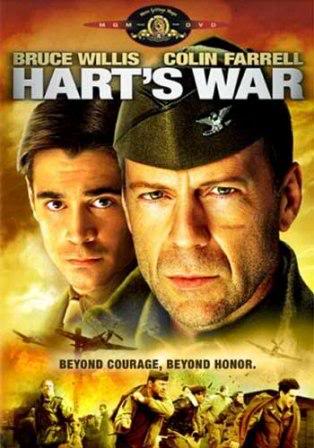
Hart´s War (2002): A Dubious POW Legal Melodrama

There are numerous movies I could have watched while lying in bed with a cold the other day. I have a big “soon-to-be-watched” DVD pile and choice is far from scarce. There are many war movies and – believe it or not – a lot of non war movies to choose from. I didn’t really feel like watching anything too heavy so Hart’s War seemed like a good option.

It actually still seemed like a very good option more than half an hour into the movie but then it started to dawn on me that this was one of those hybrid movies, that are neither this, nor that nor anything else. Yeah well, seems as if disappointment is the daughter of bad choice and false expectations.

To cut a long story short: it was not my cup of tea. Although I appreciate the subgenre of the legal drama, this came across as a pseudo legal drama that I found less than convincing.

One good thing: Hart´s War is another movie that can be added to the small list of WWII movies with African American soldiers in it (see my post on African American Soldiers in War Movies).

Apart from that, you watch it and forget it and think: Too bad it could have been good if… If what?

What’s the story? A young law student, Lt. Hart (Colin Farrell), get’s captured by a German patrol while driving someone through the woods and ends up as POW after having been tortured before  giving away some information. The highest ranking officer among the prisoners in the camp, Col McNamara (Bruce Willis) immediately dislikes him as he despises him for lying about the fact that he has collapsed after a few short days under torture. As a sort of punishment he is not allowed to stay in the barracks with the other higher ranking officers but must join the barracks of the privates and the lower ranks.

This does not work out too bad until the day two black American pilots (Terrence Howard and Vicellous Reon Shannon), two of the Tuskegee Men in fact, appear and things get nasty. Full-blown racism hits them. Hatred and aggression follow until one is executed and the other one falsely accused of the murder of a white soldier.

Even though he has only been a second year law student before the war, Hart gets appointed as the defence attorney but after a while it gets clear that it is all a sham. Secret things are happening that need a cover-up. I found the justification of what is happening morally dubious. The end does not always justify the means.

The rest of the movie is a pathetic illustration of pride, honour and glory. Highly melodramatic.

The two black actors are good, Colin Farrell is quite all right but Bruce Willis is a parody of himself. Or maybe he had something in his eye. The height of his acting seemed to consist of standing there with one eye half closed and trying to look super imposing. (Just to make things clear, I do normally like Bruce Willis.)

Meaningless pseudo-court-drama with a melodramatic ending. 2.5/5 points (2.5 points are for cinematography, choice of the topic racism in the military… Forget the rest).

How to Kill the Reputation of a Genre or Rambo: First Blood Part II

I have gotten many negative reactions when I have told people that I am interested in war movies. There are many people who think a war movie will always glorify violence and favour supermacho heroes that are close to brainless machines using guns for fun and sport.

I was always reluctant to watch Rambo until I finally gave in. I don´t think that First Blood Part I is that bad. The depiction of a Vietnam vet with post-traumatic stress syndrome is quite OK. However, I don´t like Stallone. His facial expressions are far too limited.

But when it comes to First Blood Part II… That is another story. I truly believe that this movie damaged the reputation of the whole genre.

“Do we get to win this time…?” Now seriously… Do you not consider this to be totally tasteless?

Here is what the journalist James Mottram has to add:

If the original film suggests men like Rambo are still fighting the war back home, be it on the inside or in a mountain-town, its sequel took far greater liberties. By the early 1980s, after the dust had settled on grandiose epics like Apocalypse Now and The Deer Hunter, Hollywood saw the opportunity to rewrite the history of the Vietnam War. A film so guilty of this it should be court-martialled, Rambo: First Blood Part II recast its embittered lead –  jailed in a civilian maximum-security prison between the first two films – as a one-man wager of war. A pure “fighting machine”, as his mentor and father-figure Col. Sam Trautman (Richard Crenna) dubs him, he is a nostalgic reflection of what Philip Caputo, in his 1977 book A Rumor of War , called “that savage, heroic time… before America became a land of salesmen and shopping-centres. (James Mottram in Under Fire: A Century of War Movies, p. 155)

What do you think? Did Rambo: First Blood Part II not have its part in killing the reputation of war movies?

Hope and Glory (1987): Seeing War with the Eyes of a Child

Hope and Glory is such a lyrical and beautiful movie. A rare gift of total enchantment. Like a perfect summer day.

Bill is only 9-year-old at the beginning of WWII. He is the only boy in a house full of women as his father has joined the forces. For him and his little sister the war is a great adventure. They don´t really understand the dangers. Bill collects shrapnel and plays with other boys in the ruins of the houses in his street in a suburb of London. At night they run for cover from the constant bombing. When their house burns down, his mother takes them to the country where her parents own a splendid stately home on a lake. The children enjoy idyllic  summer holidays. They  go fishing with their grumpy grandfather or play cricket. Their mother´s sisters join them, as do other family members. At the end of summer the war holds a special surprise for them. Their school has been bombed. It is easy to understand what joy this bears.

Hope and Glory is also a look back at a lost world where families were much closer, where life, despite the hardships and the war seemed somehow better than today. And of course it does remind us of our own childhood that often with hindsight seems like a lost paradise with little daily worries. Still the depiction of the war is very realistic. For us with our grown-up´s eyes there is no mistaking it for a joyride.