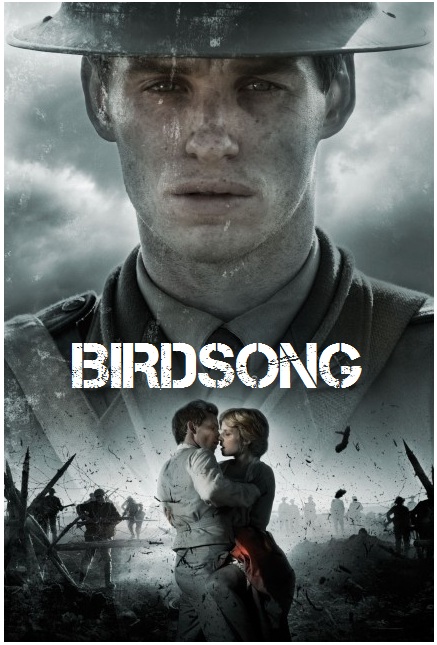
This is just a very quick post, an update really. I watched Part II of Birdsong, the BBC One TV drama based on Sebastian Faulk’s novel, on the weekend.
Here is what I wrote at the end of post I.
I didn’t mind watching it, I even liked it, but it isn’t great, it’s just very watchable. I’ll tell you my final impressions once I have watched part II.
Well, here are my final impressions. While part one was heavy on the romance element of the story, part two is much more about the war. The story is still told alternating flashbacks and episodes in 1919. Stephen has been at war for the whole duration of the war. Part II managed to change my view of the whole series completely and I have to say, I liked it a lot. I even thought that Eddie Redmayne was after all the perfect choice for this role of a heartbroken man trying to survive the horrors of the trenches.
I finally managed to watch Part I of Birdsong, the BBC One TV drama based on Sebastian Faulk’s excellent eponymous novel. They chose to tell the story moving back and forth between 1910 and 1916.
Stephen is fighting in the trenches and thinking back on how he meet Isabelle, in France, in 1910. He stayed at her house and helped her husband, a factory owner, develop new machines. Those machines were going to make a lot of the workers lose their jobs. The marriage is an odd one. The children are from a former wife, Isabelle and her husband have no children together. At night Stephen hears her cry, during the day he watches her sneak around. She tells him later that she brings bread to the worker’s families.
Isabelle is clearly what the French call a “mal-mariée” – a woman unhappy in her marriage. Stephen is much younger than her husband. He is kind, caring and very attentive. We can’t blame her for falling in love.
All this is shown in flashbacks while Stephen is fighting in the trenches. He is a Lieutenant and has the reputation of being very quiet and superstitious. He seems to have no family, friends or a sweetheart. The trench they are in is above a tunnel system dug out to lead under the German trenches where they could be blown up. The diggers hear that the Germans are digging on the other side as well and are quickly approaching. Usually miners were sent down, not infantry men, but the commanding officer decides that Stephen and his men have to go down as well. Stephen had a problem with one of the miners before and now he is sent down with him.
I’m looking forward to part II as I have forgotten the rest of the story. Or at least the rest of the love story. When I read the book I was much more impressed with the parts on WWI. Although the movie starts in the trenches, it still is much more of a love than a war movie and can’t even be called a war romance as I would only call a movie “war romance” when the romance is set during the war.
I didn’t mind watching it, I even liked it, but it isn’t great, it’s just very watchable. I’ll tell you my final impressions once I have watched part II.
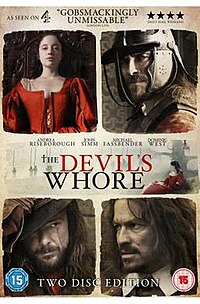
What troubled times these were. 17th century England. Thomas Rainsborough. Oliver Cromwell. The English Civil War. The Levellers. The execution of Charles I. Put all this together and use as a central figure a beautiful young woman, married three times, said to have seen the devil, accused of being a whore and surviving her execution and you have the ingredients of a very entertaining mini-series.
The Devil’s Whore or (called The Devil’s Mistress in the US) tells the story of the fictitious Angelica Fanshawe. Related to King Charles I we see her married to one of his relatives who ends up being executed. The English Civil War is seen through her eyes and its troubled history told in a very dramatic way. It makes you want to brush up your history immediately. As the addition of this fictitious noble woman tells us, the filmmakers have taken some considerable liberties, still they mange to convey how chaotic these times were. Cromwell was at the head of the Parliament, together with Thomas Rainsborough, the head of the so-called Levellers. These two men occupy two extreme positions. One wants to gain power over the parliament and have the King listen to them, while the other, as the name of the movement says, want’s all men to be the same. No more aristocracy and hierarchy. The land should be divided among everyone. As much as they are friends in the beginning, they clash and when Rainsborough is killed, it seems likely that Cromwell is responsible.
After the beheading of Charles I Cromwell is the most powerful man in England. He sends the army to Ireland and fights on many different fronts. But the war doesn’t bring peace to the country. Cromwell finally realizes that England sn’t ready yet. If he wants to restore peace there must be a new king.
I love this mini-series and have already watched it twice. Admittedly I didn’t only like it for the historical and political background but because I enjoyed Angelica Fanshawe’s story that is interwoven with the facts. In the beginning of the movie, when she is only a little girl, she sees the devil in a tree. He seems to mock her. But at the same time he transforms her into a woman, far more gutsy than women were at this time. She chooses her husbands, she speaks freely, she disguises as a man when needed and fights like a man as well.
The Devil’s Whore is an entertaining tale and a guilty pleasure set during the English Civil War, starring actors that have become famous with other movies and series. Dominic West (The Wire) plays Oliver Cromwell and Michael Fassbender (300, Inglourious Basterds, Shame, Fish Tank) is Thomas Rainsborough, John Simm (Life on Mars) is Edward Sexby and Angelica Fansahwe is played by Andrea Riseborough.
The only English trailer I found has Portuguese subtitles but that shouldn’t matter too much.
While there is a Vietnam Vet in the True Blood books who has been changed into an Iraq Vet for the TV series to make him more age appropriate, there is also the story of an Iraq vet in the US TV series Grey’s Anatomy. I was a bit surprised when series 5 introduced Dr. Owen Hunt, trauma surgeon at the Seattle Grace hospital, and to discover the back story. It’s an interesting depiction of an Iraq vet with severe PTSD, at times a bit over the top, but still believable.
Owen is a type “Ice man”, reminiscent of Sgt Brad Colbert in Generation Kill. He can handle pain and when it comes to help others he can put himself aside completely, he even functions extremely well in the Emergency Room under stressful circumstances.
His illness becomes obvious when he falls asleep. Whenever he gets woken abruptly he goes berserk as it reminds him of things he survived “over there”. When he is at relative peace he also suffers from flash backs which trouble him a lot. Whenever he is under pressure he functions remarkably well.
There is a relationship dynamic to the whole thing (obviously, as we are talking Grey’s Anatomy here) that intensifies his symptoms.
I have the odd comment of vets on this blog, some of them have done a few tours in Iraq and I would love to hear what they have to say, should they have watched Grey’s Anatomy. One question I have, is whether it would be even possible for someone to be a trauma surgeon while suffering from severe PTSD?
When I wrote my post on ANZACS the other day I realized that there are quite a few great war mini-series out there. There are certainly more than 10 but out of all those I’ve seen or heard of, I would say, the 10 that I mention below are the ten you should really not miss. They all cover different wars or different aspects of the same wars. Many of them are better than most movies. My favourites are Band of Brothers, Hornblower, Sharpe and Generation Kill.
Wings (1976) WWI Air Combat. I must admit, I haven’t seen this yet but it has a great reputation among air combat fans and should be a nice companion to the WWII based series Piece of Cake.
Danger UXB (1979) WWII – Bomb disposal unit. I liked this series when I watched it quite a bit. It gives you a good feel for what a bomb disposal unit had to go through during the Blitz. All the different types of bombs. The characters are appealing and we get a good impression of civilian life during the Blitz as well. Here is my review.
Das Boot 1985 – WWII submarine. Das Boot exists in two versions. One is the cinema the other the TV version which was twice as long. I have seen the cinema version which is one of the best war movies there is. Some people prefer the longer TV version. It’s worth checking out.
ANZACS (1985) WWI. Infantry combat. I just reviewed the final episodes of this excellent mini-series that follows the ANZACS from Australia to Gallipoli and from there to the Somme and back home again. Great combat scenes and a nice “band of brothers” feel. It also contrasts British command and Australian insubordination in a funny way. Here is my review.
Piece of Cake (1988) WWII Air Combat. The series follows the men of the Hornet Squadron during the early weeks of WWII. It shows how inexperienced boys become excellent fighter pilots.
Sharpe (1993 – 2008) – Napoleonic wars. Infantry and cavalry. Based on the novels by Bernard Cornwell this is a very elaborate and suspenseful series. In its center is the character Sharpe an enlisted man who is such an excellent soldier that he is soon raised to the rank of officer. This is problematic as he isn’t an aristocrat. He faces injustice and adversity. Sean Bean stars as Sharpe. It’s one of the best roles of his career. Here is my post.
Hornblower (1998 -2003) – Napoleonic wars. Naval combat. This is another extraordinary tale of one man’s ascent. Ioan Gruffud stars as Horatio Hornblower which might explain why I hear this series mentioned quite often by women. If you like Master & Commander, you will love this. It’s like a very long version with an appealing central character. It is based on the books by C.S. Forester. Here is my post.
Band of Brothers (2001) WWII. Infantry combat. This is one of the most amazing series. Based on the book Band of Brothers it follows the paratroopers of Easy Company from 1941 – 1945, starting in the US until the freeing of the KZ’s. The characters of this tight-knit company are very well depicted and you really care for all of them. Seeing them die or get wounded is harrowing. Some of the episodes, like the one called Bastonge, are so intense, they still overshadow most other WWWII infantry combat scenes I’ve seen before or after.
Generation Kill (2008) Iraq. Special unit. This is a series that is hard to get into, especially when you are used to others. It has a very slow build-up but after two episodes I really appreciated it. It achieves a very authentic depiction of modern warfare and shows how problematic it is to send a generation used to war games into combat. It shows how much is absolutely boring, just standing around and waiting. At the center of the unit is the “Iceman” Sgt Brad Colbert played by Alexander Skrasgard. The Iceman is an amazing character and even more so because he is based on a real person. This guy really always keeps his cool. The series is based on the account of an embedded journalist. Here’s the link to the book. And here is my post on The Iceman.
The Pacific (2010) – WWII. Infantry combat. If you do not compare this series to Band of Brothers, you will like it. It’s less the story a group of people than individual stories. The soldiers are also shown during their leaves and some love stories are incorporated. However the combat scenes are even grittier that those in Band of Brothers. Not pretty at all. My favourite episode is Rain on Cape Gloucester. Here is my Pacific short review.



 All About War Movies