Je veux voir aka I want to see (2008) or Lebanon after the War in 2006

Je veux voir is something in between a documentary and a movie. The idea for the film  came from the helplessness of the filmmakers to see how parts of their country were destroyed in a war that lasted only 1 month. They wanted to have a look at the destruction. They wanted to see for themselves and let others see. To do so, they decided to have the icon of French cinema, Catherine Deneuve, and a famous Lebanese actor, Rabih Mroué,  visit Beirut and the South of Lebanon together.

Seeing those two strangers together in a car is quite awkward at first. He is afraid of what he will see. Rabih spent his childhood in the South where his grandmother lived. Now everything is destroyed but not all the destruction they see is new. A lot is still from the civil war. The Lebanese had never really had the time to fully rebuild their houses.

It is quite surreal at moments to see a woman like Catherine Deneuve in these places. They have odd conversations about putting on a seat belt or not, which is not important to Rabih. Not anymore, as he says. Since the war such details have lost their importance.

During their trip Rabih often repeats things Catherine says or once said in a movie in Arabic.

They have to be careful as there are cluster bombs everywhere and once they stray from the path, everybody is in uproar.

At one moment Israeli jets pass over their heads and Catherine Deneuve nearly freaks out. She thinks they are under attack. But no, as Rabih explains, this is a common procedure. Israeli jets often break the sound barrier to induce fear. But they also take pictures.

Frankly, as short as it is, I found it boring at times and Catherine Deneuve´s lack of comprehension was a bit exasperating.

But the end was good and I was glad I watched it.

We see mountains of rubble. Huge, huge mountains of rubble. All the leftovers of the destroyed buildings have been brought to a place near the sea, where they are further destroyed and the rubble is shoved into the see. What struck me were all this steel bits and wires looking out of those heaps like tentacles. You only see as much steel when concrete buildings have been destroyed. This clearly indicated that those buildings were not very old. And when I saw this I remembered that Beirut was once called the Paris of the Middle East because it was so elegant and stylish…

Those days are long gone.

Still the film ends on a positive note. The two strangers have become friends and the oh so impassive actress smiles one of her rare smiles when she sees Rabih again in the evening at a gala.

A Story of Naval Combat in the Vein of Master & Commander or Why You Should Watch the TV Series Hornblower (1998-2003)

The British TV series Hornblower or Horatio Hornblower is based on the books by C.S. Forester starring Ioan Gruffudd (King Arthur) as Horatio Hornblower.

It is the movie that is closest to the fabulous Master & Commander that I have seen so far. Sure, there are older movies on the Napoleonic Wars and naval combat but this is my favourite.

I think there are a total of 8 installments. They mostly have two titles, a British and an American one.

The Duel

The Fire Ship

The Duchess and the Devil

The Wrong War

Mutiny

Retribution

Loyalty

Duty

Here are 10 reasons why you should give Hornblower at least a try:

1. If you are looking for movies that resemble Master & Commander

2. If you enjoy naval combat and some gripping rapier fights

3. If you care for a likable character who has to overcome obstacles and wins in the end

4. If you are a fascinated by this period in time and interested in the Napoleonic Wars

5. If you enjoy POW stories (one whole episode shows Hornblower as a captive)

6. If you like a gripping story

7. If two-hour movies are too short for you and you like well made mini series

8. If you are a fan of Ioan Gruffud

9. If you don’t care for too much romance but like a bit on the side  to add another dimension

10. If you like a wide range of fascinating characters, some of which are cunning and evil, others kind and heroic

WWI Movie Quotes Film Quiz 7

Today´s movie quotes quiz will lead us into the realm of  WWI movies.

The quote is followed by the solution underneath but first comes the random list for you. Anyone who wants a real challenge, skips this list!

Merry Christmas aka Joyeux Noel, The Lighthorsemen, The Blue Max All Quiet on the Western Front, Regeneration, Gallipoli, Flyboys

Quotes

[wondering why Cassidy is offering a pistol] “What’s this for?”
“Plane catches fire you got three choices: You can burn with it all the way to the ground; You can jump several thousand feet; or you can take the quick and painless way out.”
[Handing gun to Beagle]
“Good luck, gentlemen.”

Solution 1

“Everyone to their posts!”
[a moment of indecision] “Every man to his post!”
“Quickly!”
[the Scottish soldiers get in position along the trench wall]
[Someone in the German trench stands up and walks into No Man’s Land]” No, stay here! What’re you doing? Come back!”
“Well, what the hell are you doing! Shoot the bloody Kraut!”
[the Scottish soldiers look at each other; they don’t fire]
“What are you waiting for? Shoot him, God damn it! Holidays are over!”
[the soldiers shoot in the air to warn the man in No Man’s Land, who begins to run toward the French trench]
“What the hell do you think you’re playing at? Shoot him!”
[Again the soldiers look at each other, shake their heads, and don’t fire]
“Shoot him!”
[Jonathan shoots the man, who falls midway between the French and German trenches]
“Stand down from your posts.”
[They do]
“Shame on you, Gordon. Shame on you.”
[Ponchel’s alarm clock rings in No Man’s Land. Gordon looks out to see Lieutenant Audebert running to help the man Jonathan shot – Ponchel in a German uniform]
“Be silly to die disguised as a German, eh?”
“What the devil were you doing?”
“I had a German help me. I saw my mother. We drank a coffee, just like before… You have a son.”
[Lieutenant Audebert can no longer keep from crying]
“His name is Henri.”
[Ponchel dies, and Lieutenant Audebert sobs even harder. Gordon and the Major look on from their trench, Gordon grave, the Major baffled]

Solution 2

“I find it interesting that you don’t stutter.”
“I find it even more interesting that you do.”

Solution 3

“Ah, the French certainly deserve to be punished for starting this war.”
“Everybody says it’s somebody else.”
“Well. how do they start a war?”
“Well, one country offends another.”
“How could one country offend another?”
“You mean there’s a mountain over in Germany gets mad at a field over in France?”
[Everyone laughs]
“Well, stupid, one people offends another.”
“Oh, well, if that’s it, I shouldn’t be here at all. I don’t feel offended.”
“It don’t apply to tramps like you.”
“Good. Then I could be goin’ home right away.”
“Ah, you just try it.”
“Yeah. You wanna get shot?”
“The kaiser and me…”
[the others laugh]
“Me and the kaiser felt just alike about this war. We didn’t either of us want any war, so I’m going home. He’s there already.”
“Somebody must have wanted it. Maybe it was the English. No, I don’t want to shoot any Englishman. I never saw one ’til I came up here. And I suppose most of them never saw a German ’til *they* came up here. No, I’m sure *they* weren’t asked about it.”
“No.”
“Well, it must be doing somebody some good.”
Not me and the kaiser.”
“I think maybe the kaiser wanted a war.”
“You leave us out of this!”
“I don’t see that. The kaiser’s *got* everything he needs.”
“Well, he never had a war before. Every full-grown emperor needs one war to make him famous. Why, that’s history.”
“Yeah, generals, too. They need war.”

Solution 4

“Tell Major Barton that the attack must proceed.
“Sir, I don’t think you’ve got the picture. They are being cut down before they can get five yards.”
[hits the phone]
“Bloody line! Our marker flags were seen in the Turkish trenches. The attack must continue at all costs.”
“But…”
“I repeat, the attack must proceed!”

Solution 5

“By the way, Stachel… there’s an impression around that… you care more about your unconfirmed kill than you do about Fabian’s death.”
[long pause]
“Perhaps it’s force of habit. In the trenches, we couldn’t even bury the dead; there were too many of them. I’ve never had the time… to discuss them over a glass of champagne.”

Solution 6

“Hey, Scotty, you’re not Scotch, are you?”
“No.”
“Then, why do they call you Scotty?
[Scotty thinks]
“Cause I’m Irish.”

Solution 7

Michael Cimino speaks about The Deer Hunter (1979)

The Deer Hunter will always be one of the most fascinating Vietnam war movies. It´s not an easy movie and it is one of those you have to watch again to truly understand it. I wanted to write a review of it many times but was never satisfied with what I came up with. While waiting for the ultimate inspiration  I found this video post of an interview with the director of the film, Michael Cimino.  I found it quite interesting, especially since the interview is interwoven with bits of the film. Really well done.

Hope you will like it too.

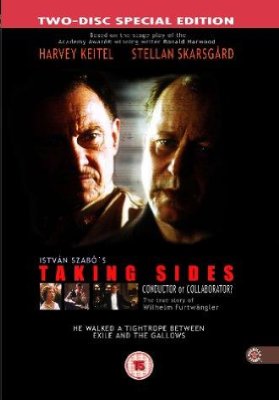
Taking Sides (2001) or The Denazification of a Legend

Istvan Szabo’s Taking Sides tells the story of the so-called Denazification of one of the greatest conductors of the 20th century, Helmut Furtwängler. (As can be read in the Jewish Virtual Library Denazification was the name given to “the efforts made by the Allies to remove active members of the former National Socialist Party from official public office and influential positions in Germany after World War II.”). The events take place in post-war Berlin. Furtwängler was the conductor of the Berlin Philarmonic. Before going to trial he is being questioned by an American investigator, Major Arnold, who shows no mercy and treats him not much different from the way the Gestapo treated people they questioned. Whatever Furtwängler says is taken against him. When he has nothing to say it is taken against him as well. This is a witch-hunt. There is not much action in this movie that’s why the two actors had to be extremely good. And they are. Harvey Keitel as the self-righteous Major who conducts the investigation is excellent. But Stellan Skarsgard starring as Furtwängler is amazing. This is sublime acting. I always liked him but in this movie he proves to be capable of acting far beyond the average.

Furtwängler is accused to have been a member of the Nazi party, to have been friends with Hitler, Himmler and Goebbels. To have known what was going on but to choose to stay anyway. It becomes soon clear that none of this is true and therefore Major Arnold tries to prove him at least morally guilty. Even though he has helped many Jews to escape, Arnold thinks his staying is reproachable. There is a lot of food for thought in this movie. Furtwängler seems to have believed that music and art could better people and that it was his duty to stay. But he was also naïve to an incredible extent. An intellectual living in an ivory tower.

Before starting to question him and during the weeks of the interrogation Arnold watches movies of the concentration camps. The original footage we get to see is one of the most horrible I ever seen. A huge mass of naked emaciated bodies are being shoved away like dirt… This fuels Arnolds’s hatred and lets him lose the right perspective.

One of the best elements of the movie is the clash of these two personalities; the gentle, well-mannered, soft-spoken old-world artist and the aggressive, vulgar and ignorant American major.

The movie does not only take place in the interrogation room. We follow the two young assistants of the major (played by Moritz Bleibtreu and Birgit Minichmayr), both German, one of Jewish origin and just returned from the States, on their outings in the city. This adds a further dimension to the film and we get a feel for post-war Berlin.

Taking Sides has also one of the most beautiful moments I have ever seen in a war movie. In an eerily beautiful scene we see an orchestra play in a ruin in the pouring rain.

As stated before, apart from being interesting, fascinating and underlined by beautiful classical recordings (Beethoven, Bruckner) this movie lives from the actors. The leading actors are outstanding but the supporting actors are very good too.

At times Taking Sides reminded me of Judgement at Nuremberg.

This is a movie for people interested in the post-war era, Denazification, classical music, Furtwängler and moral questions tied to WWII Germany. Is it understandable that Furtwängler stayed? Would it have been worse if all the good people had left? Are we allowed to think of self-preservation when faced with the mass destruction of others?

Instead of a trailer I decided to include a scene from the movie.