Omagh (2004) Irish TV Movie on the Omagh Bomb

I have seen a few movies on the Troubles. Some were good, a few were outstanding. Omagh, I’m afraid, isn’t one of them. I’m not saying it isn’t sort of interesting as it explores, more than anything else, the reactions of the people affected by the “Omagh bomb”, namely the families of the victims, the support groups, the police and the politicians. But interesting doesn’t necessarily equal well done. I don’t mind TV productions but I’m not keen on shaky handheld camera, weirdly cut images and pseudo-documentary style. Blood Sunday (here is my review) has a very similar approach but was much better, I thought. Still, I didn’t mind watching it as I have always been interested in Irish history.

Omagh is a little town in Northern Ireland. On Saturday  15 August 1998, a car bomb went off in the town center, killing 29 people and injuring another 220. The beginning of the movie, focusing on one young man, Aiden Gallagher, and his family is very powerful. We know what is going to happen and to see them before the tragedy and knowing one of them is doomed, is quite uncanny. Also the anxious moments after the family hears that there was a bomb and their son and bother doesn’t return are very well done.

The responsible people for the Omagh bomb were the so-called Real IRA, a splinter group of the Provisional IRA whose members were opposed to the peace treaty. The Troubles are such a complicated chapter in Irish history and as much as the movie tries to capture this, for the outsider it stays quite confusing.

That the British Prime Minister Tony Blair and the Sinn Féin leaders condemned the attack didn’t help the families much. What follows Aiden’s burial, is a close examination of the aftermath of the bombing. Aiden’s father tries to get the help from anyone he can. Politicians and police alike. He joins a support group and together with their members they try to find out who is responsible for the bombing. They look for the individual names. After a while Michael is contacted by a man who was an informant and spying on the Real IRA. He provides him with a list of names. He pretends having given information on the bombing to an intelligence service way before it happened.

Michael tries to pursue this and investigates on his own, confronting the police but to no avail. After a few months he is so down that he has to let go and try to overcome the grief for his son.

Some months later the support group is summoned by the police. An ombudsman tells them that not only did they find proof that the informant told the people in charge about the bomb threat but that the intelligence service had also tried to cover it up. In doing so, evidence that could have led to arrests was lost.

“Bad management and lack of judgment of a senior intelligence officer” was the final verdict of the ombudsman. Sadly there were no consequences.

It makes me feel a bit bad to say that I didn’t like this film. It seems as if I was saying the incident wasn’t horrible. I’d like to emphasize, that this isn’t the case at all. What happened in Omagh is horrible but the way it has been filmed was just not convincing.

The Thin Red Line (1998) Part I The Review

Sometimes we watch a movie and love it. A few years later we watch it again and have no clue why we ever liked it. This happened to me a few times, fortunately it isn’t all that often.

I have seen the The Thin Red Line three times by now, the first time I liked it so much that it actually triggered my interest in war movies.

The second time, shortly after the first, I still liked it a lot. But that was 7 years ago and since then I have seen numerous other movies, excellent ones, good ones and abominable ones as well.

Watching it for a third time made me somewhat wary. What if…?

I shouldn’t have worried. After watching it for the third time I think it is the most radical, most thoughtful, most provocative and most difficult anti-war movie that has ever been made.

The Thin Red Line is truly a lyrical and poetical meditation on death and dying. It’s far more than just a war movie. It is transcending the genre.

I decided to dedicate more than one post to this stunning movie, exploring different aspects (something I would like to do for other movies as well in the future).

I will cover the following topics.

Part I. Review

Part II. On Death and Dying

Part III. Nature and Evil

Part IV. The Actors and the Characters

Part V. Saving Private Ryan versus The Thin Red Line

Part I The Review

In many war movies there is a bridge to defend, an outpost to be kept or a hill to be taken. Terrence Malick’s The Thin Red Line, based on James Jones’ eponymous novel, tells the story of the taking of a hill. It’s 1942, on the island of Guadalcanal, which is part of the Solomon Islands, in the Pacific.

The movie opens on an idyllic scene. Two soldiers, one of them Private Witt (James Caviezel) have gone AWOL. They live among the natives in a paradise-like place. They swim and play with the kids, surrounded by the beauty of tropical nature. This will not last. A patrol boat will come and get them and together with the other soldiers from C-Company they are sent on a mission to take a hill on top of which is a Japanese bunker.

This is one of those typical suicidal missions. Driven by a mad Colonel (Nick Nolte) who cares about nothing but his own glory the men are led by the gentle and courageous Cpt Staros. Staros cares for his men, unlike Colonel Tall and even risks being court-martialled for disobedience in order to save his men from certain death. Tall wants them to attack frontally despite the fact that the Japanese have all the advantages. They are well dug in, sheltered by their bunker, looking down on those crawling men. Staros wants to bypass the hill. A far better and careful decision that was made after seeing how the situation really was, while Tall decided from afar, having no clue how the situation looked closeup.

The scenes that follow the beginning are alternating between intense infantry combat, scenes of dying and death, nature shots, interior monologue in voice-over and also flashbacks of the soldiers lives before the war. Witt thinks of his childhood and the peaceful idyll in the tropical paradise, Staros is very religious and Private Bell imagines his wife and their love for each other.

The losses are high, the death scenes harrowing and gruesome. Thanks to Staros’ disobedience the attack doesn’t lead to total disaster and the men are victorious in the end. However he has to pay a prize, he will be sent away under the false pretense of suffering from malaria. No matter how many soldiers’ lives he saved, he will never ever be in command again.

The Thin Red Line draws a few interesting character portraits to which I will come in Part IV of this series.

The score of the movie has been written by Hans Zimmer and underlines the poetical versus brutal aspects of the movie.

If you already want to know more about the cast here is an earlier post: My Favourite War Movie All-star Cast

Ken Loach’s Land and Freedom (1995) A Story of the Spanish Civil War

At the beginning of Ken Loach’s movie Land and Freedom, we see a young woman sorting out the things her late grandfather has left behind. She finds a suitcase full of black and white photos, newspaper articles and letters that show her a hidden part in her grandfather’s life. Little had she known that he had fought in the Spanish Civil War and loved a Spanish woman.

In 1936 David Carr (Ian Hart) is an unemployed miner and member of the British Communist Party. When someone from the Spanish Communist Party shows up and tells them about the Civil War in Spain in which the people fight against General Franco’s Army and the rich landowners, David spontaneously decides to go to Spain and fight for the rights of the people.

On his train journey he meets people from the Spanish militia, part of the POUM, a communist group that fights independently of the International Stalinist Brigades. He has no particular place to be and decides to join them. The people in the little group he is fighting with are all idealists. They come from all over the world, the US, Germany, Italy, Ireland, the UK. They want to fight for the rights of the peasants and the poor and not join the Stalinist Brigades which they consider to be corrupt and only interested in their own cause.

David who at first seems to think he is living some kind of adventure, soon faces the harsh reality. Not only is the fighting often heavy and there are casualties but they are badly trained and equipped and the Stalinists keep the weapons from them. When one of those faulty guns explodes, David is injured and sent to the hospital. Blanca, one of the group visits him in Barcelona, after he has come out of the hospital. They spend a night together but she leaves disgusted when she finds out that David has decided to join the Stalinists.

David will regret his decision soon enough and return to his old POUM group. The movie ends tragically and on a note of utter disillusionment.

Land and Freedom was absolutely not what I had expected and I assume that is exactly what Ken Loach was aiming for. We all have our ideas about the Spanish Civil War, some very romantic ones mostly. We know that Hemingway fought in Spain and so many other writers, painters… It seemed to have been one of the very rare wars with a justified cause to fight for. Ken Loach destroys all our romantic ideas and that is why the movie is good and annoying at the same time. He tries to show how it must have been. The fights and differences within the Communist Party and their subgroups, the endless talking and theorizations. The middle part of the movie is one long annoying and boring conversation and dispute about collectivism.

An aspect I wasn’t familiar with is the fact that women were only allowed to fight alongside the men at the beginning of the war. Later it was decided that they had to do “womanly” things like cooking or being nurses. I thought that women fought all through this war. Another shattered illusion.

Loach has earned a lot of praise and got also a lot of scolding for this movie. Some think that finally someone told it as it was, others think he dirtied the memory of the Spanish Civil War.

I am a fan of Ken Loach‘s movies, he has done quite a few that I liked a lot, although I wouldn’t go as far as saying that I liked Land and Freedom, I must say, I appreciated it. I felt somewhat stupid for having to realize that my idea of the Spanish Civil War had maybe been a tad too romantic as well.

Unfortunately there was no trailer of Land and Freedom, only the first part of the movie.

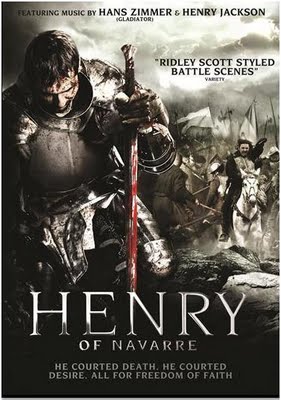
Henry of Navarre (2010) DVD Giveaway

It is the mid-16th Century and France is awash with blood, as the protestant Huguenots fight for survival against dark forces led by the treacherous Catherine De Medici. When she orchestrates the ultimate betrayal at the infamous St. Bartholomew’s Day Massacre, King Henry IV will fight his life’s greatest battle to ensure her treachery does not go unanswered…

Based on the novel by Heinrich Mann, experience an epic chronicle of one man’s heroic struggle against overwhelming forces in this action-packed and spectacular “5- STAR(Cambridge Film Festival) motion picture event with RIDLEY SCOTT STYLED BATTLE SCENES(Variety).

I’m really looking forward to watch this movie. This is the type of epic period drama that I love. And since I’m a sucker for great film music and love Hans Zimmer who has written the score of Henry of Navarre, there is twice as much to look forward to. Based on Heinrich Mann’s eponymous novel, starring Julien Boisselier, this international production offers large-scale cinema.

What’s even better, I am able to give away one DVD of Henry of Navarre courtesy of Showbox Media. All you have to do is leave a comment. I will draw the winners next Saturday and announce them on the following Sunday.

The giveaway is open internationally but the DVD is REGION 2 coded.

Henry of Navarre is out to buy on Blu-ray and 2 disc-DVD on 4th July 2011, courtesy of  Showbox Media Group.

The giveaway is now closed.

The Last Samurai (2003) An Epic Tale

Take an American and put him into an exotic decor. Most of the time that goes very wrong. Occasionally it doesn’t and what comes out is an entertaining guilty pleasure like The Last Samurai, a movie midway between The Last of the Mohicans and Memoirs of a Geisha. Although it is not at the same level of Glory, one of my Top 10 war movies and Edward Zwick’s masterpiece, Last of the Samurai is equally beautiful.

Captain Nathan Algren (Tom Cruise) is a hardened, disillusioned and alcoholic veteran of the Civil War. Touring as special attraction with some sort of circus, he has clearly seen better days. He is haunted by what he saw in the war, the killings of the Indians, the battles. While in this sorry state, he is approached  by some Americans who want to hire him as military advisor for a newly established Imperial Japanese Army. If it pays good money, he would probably sell his mother, so he doesn’t hesitate long and follows the men to Japan.

The army consists mainly of peasants with no experience whatsoever in warfare. Despite their not being ready, one of the emperor’s advisors wants Algren to lead them to battle against rebellious Samurai who do not want to accept the changing of the times.

The moment when they are surrounded by these warriors in their incredible armour, it’s obvious they will lose the fight. In the chaos and mayhem that follows, Algren who has been severely wounded is taken prisoner by the Samurai and brought to their village high up in the mountains.

The landscapes and images are extremely beautiful, the ways of the Samurai seem mysterious and we can easily understand that Algren is fascinated. The moment he arrives in the village – and not only because the woman who takes care of him is very beautiful – he tries to immerse himself in the culture and the rituals of this ancient tradition.

In the months that he spends with them he learns their ways of living and fighting and becomes the friend of the their leader Katsumoto (Ken Watanabe). When the imperial army attacks, he fights with him until the last.

I enjoyed the final battle and seeing the battle formations, it reminded me a bit of Waterloo.

I was surprised that I liked this movie I had thought it would be tacky but it is really not bad at all. Plus I have a thing for the Samurai armour. It’s one of the most beautiful armour in history. And their weapons are also quite fascinating, they didn’t use firearms.

It’s a very visual movie, with a good story. In other words, excellent entertainment.