The Admiral aka Admiral (2008): Not a Russian Master & Commander but Anna Karenina meets the Russian Revolution

I am not sure how many people outside of Russia know Admiral Kolchak. I’m afraid not a great many. At least I did not know him. But not knowing this historical figure  may  lead to an odd situation. Either people  watch this movie for the wrong reasons and will be disappointed or they might not watch it at all. This would actually be a pity since The Admiral is a very sumptuous movie. Beautifully filmed and very gripping.

As stated in the title The Admiral is not a Russian Master & Commander. After the initial ten minutes of naval battle scenes there is no more fighting on ships. These initial ten minutes however are very gruesome and intense. After this sequence the movie starts to resemble Anna Karenina for many reasons. It is a beautiful tale of tragic adulterous love and full of portents, like the breaking glass at the ball in the beginning which reminded me of the accident scene in Anna Karenina. (By pure chance I have just very recently watched Anna Karenina,  that is why I realised how very similar they are with regards to the love story apart from the fact that this is a true story.)

The love story between Kolchak and Anna, who are both married when they meet,  is only one part of the movie. It  is interwoven with the part  that follows Admiral Kolchak.  1917 after he has  successfully fought the Germans at sea, the Russian Revolution strikes and changes everything for the aristocracy. Kolchak flees to Japan and returns after a few months to head the anti-Bolshevik white troops that were to fight the Red troops. This is the beginning of the Russian Civil War that we see in all its ugliness. If Kolchak had been succesful there would maybe never have been a Soviet Union. Well, he was not successful. In the end he is taken prisoner and sentenced. Anna, the woman he loves, follows him even though they would have let her go. Quite a sacrifice.

It is quite a fascinating story and I have a feeling I am not doing it justice here. If you are interested in history, and especially Russian history, you should watch it. If you like tragic love stories then you should watch it as well.

My only reservations regard the flow. There a quite a few breaks in the movie, it seems a bit disrupted at times.

Do not watch the trailer as it is highly misleading and gives the impression of a pure naval combat movie.

Savior (1998): An Extremely Grim Movie about the War in Bosnia

Thanks to TPC who commented on my post “Welcome to Sarajevo” I discovered this movie and have finally watched it.

Oh – my – God.

Before even trying to attempt to describe this movie let me quote from a NY Times review by Stephen Holden:

As Mr. Quaid’s character, Guy, perilously makes his way through the war-torn countryside, the film portrays a land whose people, regardless of ethnicity, have been reduced to animalistic survival tactics by the violence that has devastated the region. The war has turned seemingly ordinary people into potential murderers, rapists and torturers. And the movie’s unblinking scenes of atrocities are among the most graphic and upsetting ever shown in a commercial film.

This sums up quite a lot. Savior is really heavy stuff and so depressing. The goriest battle scenes from any WWI, WWII or Vietnam movie can never get as depressing as this. Like the war in Rwanda. A tribal war.

Gritty realism is not all we see and I did have my problems with this movie. There is  a very Christian undertone all through it. Or not even an undertone, rather a loud drone. The character change of Guy (Dennis Quaid) is psychologically not very convincing. I can understand that he goes berserk after his wife and his son get blown up in a terrorist attack but from then on… He escapes with his friend (Stellan Skarsgard – not one of his better roles and far too short) to the French Foreign Legion and from there we follow him to Bosnia where he is fighting as a mercenary on the side of the Serbs. We see him commit atrocities until he and another soldier, Goran, get to drive Vera, a pregnant young woman back to her family. She has been raped by a muslim and is now being treated as if it was her fault. Her fellow Serbs hate, blame  and despise her for this. Goran is a brute and what we see him do to an old woman and later to Vera is almost not watchable. I tell you, not for one second do you want to imagine yourself in the situation of one of those women.

The illustration of women as victims in war movies does find its sad culmination point in Savior.

After Vera has given birth under the most inhuman circumstances something snaps in Guy and he seems to reclaim  his humanity. From then on he is “The Savior”. It is not very subtle that the filmmakers chose to show us repeatedly that Guy is wearing  a cross with a three-dimensional Christ nailed to it.

The bleak parts that deal purely with this godforsaken war are overwhelming. Maybe it would really have been too hard to watch if they hadn’t tried to gloss it over a bit. Be is as it may… This movie exudes such an honest try at showing the atrocities of this war that I really think it should be watched. What makes me extremely thoughtful is to think that if these atrocities had been invented by a script writer we would say: “What a sick mind!”. But this did happen… And not even so long ago…

A brief remark about the music. This movie has a very beautiful score, in parts traditional regional folk songs sung by mysteriously haunting female voices. Some of it can be heard in the trailer.

What do you think? Any people from ex Yugoslavia reading this? Is Welcome to Sarajevo the better movie?

I am not sure if Welcome to Sarajevo is better, but it is less controversial. When it comes to liking I must admit I am partial to Savior. I liked it much more than Welcome to Sarajevo. There is something in the character of Guy that I could relate to. Probaly his utter loneliness that encloses him like an aura. This cold sniper personality  he is wearing to shield himself and hide that he has been deeply wounded… I don’t approve of his acts, of course, but from an emotional point of view I think I get him.

Movies on Pearl Harbor: Pearl Harbor, Tora!Tora!Tora!, In Harm´s Way, From Here to Eternity

Any nation´s traumatic experiences have led to numerous attempts to capture the event in a movie. Pearl Harbor is no exception. There are a great many Pearl Harbor movies. Some are very well-known, others hardly at all. Some are very good, others rather not.

I would like to present four of those I have seen. Three of them are also romances, one is a pure war movie. Each and every one of them might very well get an extensive review in the future, but here, as teasers, four short glimpses at four special movies.

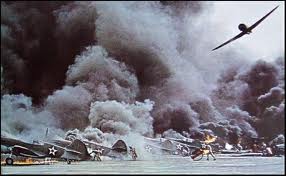
The one that generally everybody will immediately think of is the Jerry Bruckheimer production Pearl Harbor (2001) . The main theme is the love story of two men (Ben Affleck and Josh Hartnett) with the same woman (Kate Beckinsale), a nurse. They are both fighter pilots and at the time when Pearl Harbor is attacked, they are stationed there. The movie starts slightly before the attack and ends shortly afterwards. It doesn’t try to show the other side. The Japanese are just plain bad. Period. As corny as this movie may be (although I think it works as a romance), it still shows an impressive re-enactment of the attack. For that and for a few exciting aviation scenes it is worth watching.

Tora! Tora! Tora! (1970) is really different. This US/Japanese co production is an incredible attempt at showing both sides. And it does manage to do so. The Japanese are shown in all their tragic complexity and their fear, as Admiral Yamamoto states, that all they have done is to “awaken a sleeping giant and fill him with a terrible resolve”,  is quite moving. This is the best movie if you really want to get a feel for what was happening and why the involved parties acted and reacted like they did. It is filmed as well in  English as in Japanese which heightens the authenticity. A must-see. An eye-opener. A truly good movie.

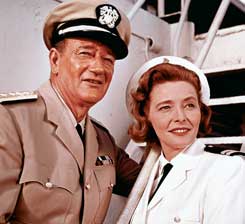
Of course there had to be a Pearl Harbor movie with John Wayne in it. Otto Preminger´s In Harm´s Way (1963) starts just shortly before the attack, shows it from the perspective of a naval ship and later follows the main characters into battle in the Pacific. It is one of those black and white all-star casts that really works (Kirk Douglas, Henry Fonda, Patricia Neal, Dana Andrews). The acting is superb. Pictures are nice, the background story, also a love story, is convincing, and the score is very good. An enjoyable watch. Not very heavy on history but still a good movie and a fine example of a film dedicated to this disastrous event.

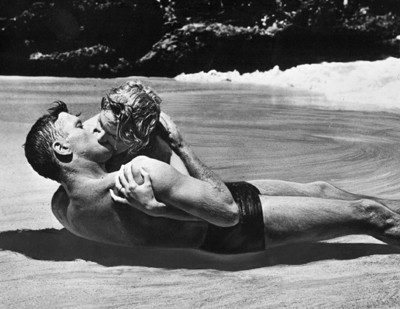
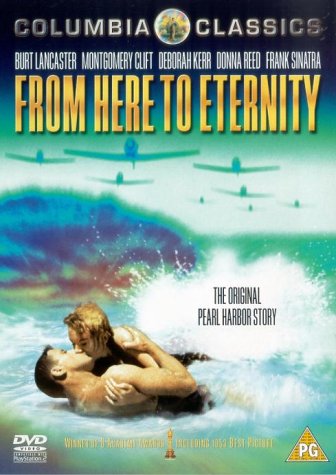
Don´t we all know this picture? It is one of the most famous movie stills ever. From Here to Eternity (1953) is a movie I totally love. It is my favourite of the four, even though I must admit Tora! Tora! Tora! is way more informative. The story that is based on the novel of James Jones is  intense and dramatic.  The acting is fabulous. Go and try to find this nowadays.  From Here to Eternity is also an all-star cast, with Burt Lancaster, Montgomery Clift, Frank Sinatra, Deborah Kerr and Donna Reed. This movie is one of the very great classics, right up there with Casablanca. Yes, that’s what I think. A movie to watch and re-watch. It has won multiple Oscars. You can see Monty in one of his best roles ever. Pearl Harbor is not the movie´s main theme but it does end with the attack on Pearl Harbor. It tells the stories and love stories  of different army soldiers on the eve of the attack  and somehow seems to juxtapose the tales of the people, their sorrows and woes with this national catastrophe.

One thing is for sure, pick any of them and you will not regret it. Even Pearl Harbor is at least good  old escapist entertainment.

Hart´s War (2002): A Dubious POW Legal Melodrama

There are numerous movies I could have watched while lying in bed with a cold the other day. I have a big “soon-to-be-watched” DVD pile and choice is far from scarce. There are many war movies and – believe it or not – a lot of non war movies to choose from. I didn’t really feel like watching anything too heavy so Hart’s War seemed like a good option.

It actually still seemed like a very good option more than half an hour into the movie but then it started to dawn on me that this was one of those hybrid movies, that are neither this, nor that nor anything else. Yeah well, seems as if disappointment is the daughter of bad choice and false expectations.

To cut a long story short: it was not my cup of tea. Although I appreciate the subgenre of the legal drama, this came across as a pseudo legal drama that I found less than convincing.

One good thing: Hart´s War is another movie that can be added to the small list of WWII movies with African American soldiers in it (see my post on African American Soldiers in War Movies).

Apart from that, you watch it and forget it and think: Too bad it could have been good if… If what?

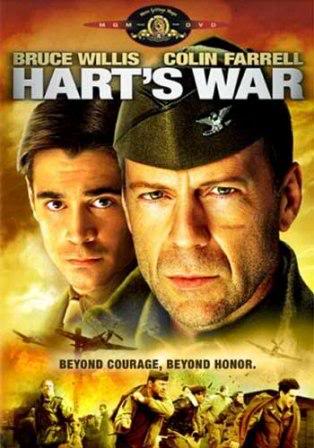
What’s the story? A young law student, Lt. Hart (Colin Farrell), get’s captured by a German patrol while driving someone through the woods and ends up as POW after having been tortured before  giving away some information. The highest ranking officer among the prisoners in the camp, Col McNamara (Bruce Willis) immediately dislikes him as he despises him for lying about the fact that he has collapsed after a few short days under torture. As a sort of punishment he is not allowed to stay in the barracks with the other higher ranking officers but must join the barracks of the privates and the lower ranks.

This does not work out too bad until the day two black American pilots (Terrence Howard and Vicellous Reon Shannon), two of the Tuskegee Men in fact, appear and things get nasty. Full-blown racism hits them. Hatred and aggression follow until one is executed and the other one falsely accused of the murder of a white soldier.

Even though he has only been a second year law student before the war, Hart gets appointed as the defence attorney but after a while it gets clear that it is all a sham. Secret things are happening that need a cover-up. I found the justification of what is happening morally dubious. The end does not always justify the means.

The rest of the movie is a pathetic illustration of pride, honour and glory. Highly melodramatic.

The two black actors are good, Colin Farrell is quite all right but Bruce Willis is a parody of himself. Or maybe he had something in his eye. The height of his acting seemed to consist of standing there with one eye half closed and trying to look super imposing. (Just to make things clear, I do normally like Bruce Willis.)

Meaningless pseudo-court-drama with a melodramatic ending. 2.5/5 points (2.5 points are for cinematography, choice of the topic racism in the military… Forget the rest).

How to Kill the Reputation of a Genre or Rambo: First Blood Part II

I have gotten many negative reactions when I have told people that I am interested in war movies. There are many people who think a war movie will always glorify violence and favour supermacho heroes that are close to brainless machines using guns for fun and sport.

I was always reluctant to watch Rambo until I finally gave in. I don´t think that First Blood Part I is that bad. The depiction of a Vietnam vet with post-traumatic stress syndrome is quite OK. However, I don´t like Stallone. His facial expressions are far too limited.

But when it comes to First Blood Part II… That is another story. I truly believe that this movie damaged the reputation of the whole genre.

“Do we get to win this time…?” Now seriously… Do you not consider this to be totally tasteless?

Here is what the journalist James Mottram has to add:

If the original film suggests men like Rambo are still fighting the war back home, be it on the inside or in a mountain-town, its sequel took far greater liberties. By the early 1980s, after the dust had settled on grandiose epics like Apocalypse Now and The Deer Hunter, Hollywood saw the opportunity to rewrite the history of the Vietnam War. A film so guilty of this it should be court-martialled, Rambo: First Blood Part II recast its embittered lead –  jailed in a civilian maximum-security prison between the first two films – as a one-man wager of war. A pure “fighting machine”, as his mentor and father-figure Col. Sam Trautman (Richard Crenna) dubs him, he is a nostalgic reflection of what Philip Caputo, in his 1977 book A Rumor of War , called “that savage, heroic time… before America became a land of salesmen and shopping-centres. (James Mottram in Under Fire: A Century of War Movies, p. 155)

What do you think? Did Rambo: First Blood Part II not have its part in killing the reputation of war movies?