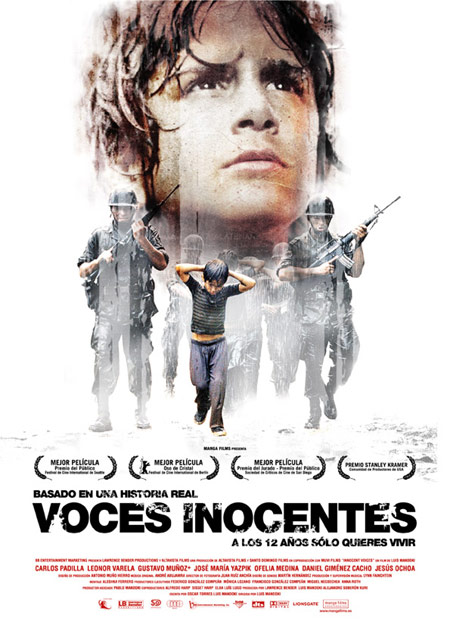
Voces Inocentes aka Innocent Voices (2004) Children as Soldiers in the Civil War in El Salvador

Based on a true story, Luis Mandoki’s Voces Inocentes aka Innocent Voices is going directly on my list of all time favourites, regardless of the genre. This Mexico/US/Puerto Rico co-production is an astonishingly beautiful movie despite the atrocities it depicts. It is simply awesome and as good as Army of Crime about which I raved last year. It is one of the movies on my Children in War Movies List and a s such worth watching in any case.

What makes this movie so incredible is the fact that it works on many levels. It is as much the story of a childhood and a little boy, as an in-depth look at a way of life we are less than familiar with and a civil war we have almost forgotten about. Last but not least it shows the portrait of a mother (Leonor Varela) whose spirited fight and love for her children makes her one of the most memorable and dignified characters I have seen in any movie.

The war, that started in 1980 and lasted 12 years, was initially a conflict between the army and the campesinos, the land owners, over land rights. When they didn’t come to an arrangement the campesinos formed a guerilla, the FMLN, to defend their rights. The war escalated into a bloody civil war. On top of that the US felt the urge to provide the Army with weapons and heir assisstance, fearing that the guerrilleros would be supported by the USSR. The war cost 75’000 lives and over 1 Mio people fled the country. Lacking men, the Army recruited young boys who were barely 12 years old. Oscar Torres, who wrote the script, is the model for Chava, the little boy, whose story we see.

The movie starts with soldiers escorting little boys holding their hands over their heads, to an execution place. They walk in the pouring rain and we hear Chava’s voice in the off. It’s a beautifully filmed scene that immediately sets the tone for the whole movie. We will see many scenes that take place in the pouring rain and are of great beauty despite the fact that they show horrors.

Chava (Carlos Padilla) lives alone with his mother and his little brother and sister. The father has fled the country and gone to the US. Chava’s young and beautiful mother, Kella, is truly a memorable character. Tender and fierce at the same time, she defends her children and fights for their survival. These are the poorest of the poor, their houses are only shacks with cardboard roofs. Kella tries to make a living as a seamstress. Imagine living in a shack when at night there is fighting in the roads. Bullets easily enter the walls of the houses and come flying past your head, there is hardly any cover apart from mattresses that are build up against those thinnest of walls. It is hard to imagine that people not only lived in such poverty but had to endure a war like this that threatened their lives on a daily basis. Many got killed like this, in their own house.

Young Chava is a cheerful and funny little boy. Despite the war, he plays with his friends, falls in love with a little girl, fights with his mother, finds a means to earn money. Even though they have nothing, live precariously, his childhood seems almost enchanted. The tiniest things amuse him, he lives with great intensity, knows no boredom.

The main theme of the movie is the threat that the soldiers will come and get Chava and his friends. We see many scenes in which little boys are recruited by force. The procedures are quite upsetting. Some of the boys around Chava finally decide to join the guerilla in order to avoid the military. And that is what little Chava does in the end as well. The final scene of the movie brings us back to the beginning. Chava and his friends have joined the guerilla and were caught by the Army. Unless they get help, they will most probably be executed.

The actors are amazing, especially the children. They are really awesome. The movie is full of beautiful scenes that allow us to have a look at these precarious lives in poverty. They convey a melancholic beauty that is quite special. There are a few songs that are important in the movie. They had been forbidden by the army but were listened to anyway.

The movie manages to mix a lot of different tones. At times it is sad and melancholic, at times it is thoughtful almost meditative, then again it’s funny or just downright tragic. Innocent voices is a gem, a must-see.

One final word: the people from El Salvador were apparently not entirely happy about this movie because none of the actors is from El Salvador and it has been filmed in Mexico.

Silent Night (2002) Christmas in War Movies I

This review is part of a sequence of reviews of war movies that have Christmas as their main theme. There are many war movies in which a part takes place during Christmas or in which it is evoked but that are not the ones I’d like to focus on. I want to focus on those that really center on it.

The first one I’m reviewing is, as you can see, Silent Night, A  Midnight Clear, Joyeux Noël and maybe one or two older ones will follow.

The TV drama Silent Night is based on true facts. It is set on Christmas Eve 1944, just after the Battle of the Bulge. A mother and her young son are seeking refuge in the family’s hunting lodge in the middle of the Ardennes Forest. They walk through the war-torn woods, approach the front line and pass dead bodies, troops of soldiers and tanks.

They have just arrived at the lodge when two American soldiers arrive, carrying one of their wounded. The woman lets them stay reluctantly but makes them leave their weapons in front of the house. Elisabeth Vincken (Linda Hamilton) is not what you would call a patriot. She has lost her eldest son at Stalingrad, her husband is probably dead as well and the youngest, Fritz, would like to join the Hitler Youth which she wants to prevent at all costs.

While they are looking after the badly wounded soldier, a group of three German soldiers arrives at the hut and the encounter almost ends in mutual shooting. Elisabeth is a very strong woman, very determined and persuasive. After some initial discussions and negotiations they agree to leave their weapons behind, enter the house and spend the night there in peace.

I don’t think that anyone present during this Christmas dinner was likely to ever forget it. It would certainly be the most memorable Christmas of their lives. They sit around the table, share their food and stories, talk about the way in which this and the former war affected them. Still,  tensions do not subside completely. The German lieutenant has a particularly hard time to stay peaceful. He is bitter and aggressive, however, after a moment of escalation, he starts to see how absurd this all is and gives in as well. There is a final test that will show if these men have truly become friends in one evening. And if so, will they stay friends later on?

One  thing, as often, that truly bothered me were the bad accents. Americans speaking German with heavy American accents and then fake English accents. But cheer up, I have been assured that it doesn’t bother you if you don’t speak German.

The movie has a few very sentimental moments but it is overall not bad at all, no it is quite a pleasant movie that achieves to capture the spirit of Christmas. Recommended Sunday afternoon viewing with loads of snow, drama and some genuinely heartfelt moments.

I also included Silent Night in my update Children in War Movies List.

Grave of the Fireflies aka Hotaru no haka (1988) An Anime War Movie

Thanks to Novroz who mentioned Grave of the Fireflies pointing out I should review it on this site I finally watched this very beautiful anime last night.

Animes are maybe not everybody’s cup of tea and I am far from being an expert having only seen the other Studio Ghibli treasure Princess Mononoke aka Mononoke-hime still I know when I see a masterpiece. And Grave of the Fireflies is a masterpiece and should have been added on my Children in War Movies List before. This is an artfully drawn anime with a very moving story. It is a must-see for anime fans and people interested in war movies alike.

War does affect people in different ways. Some fight in it and die in it. Some get injured and are sent home. Others return suffering from post-traumatic shock. But many stay at home. All the old people, the children and the women. What about those people on the homefront? What happens to them? How do they cope with constant air raids, lack of food and other supplies? How do children cope? This is what Grave of the Fireflies shows us. You have to watch the first five minutes very carefully or you might not get the full meaning of the movie. It is quite subtle and could be missed.

Seita and Setsuko, a brother and his little sister, are two Japanese children whose lives are profoundly affected by the war. Their mother dies in an air raid while their father, an officer of the Japanese Royal Navy, is at war. The two children find refuge at the house of their aunt. But close quarters and lack of food doesn’t help and they are soon not welcome any more. Left with some money the children leave the house of their realtives and live in a shelter outside of town. The brother who is ten years older cares touchingly for his little sister but he can hardly find anything to eat. He tries to buy something but no one sells anything. He tries to steal and gets beaten up. The little girl gets weaker and weaker and finally falls very ill. When Japan surrenders Seita hears from someone that the Navy has been completely destroyed. His father is very probably dead as well.

The end of this movie is particularly good. It’s very sad and I can understand that people who are less familiar with war movies in general might be very shaken. I don’t think it is advisable to watch it with little children although it is not gruesome but the way death and war are treated is very emotional. The little girl is absolutely amazing. So realistic.

Even though this is a war movie it is also a meditation on life’s fragility and fugacity. A very poetical and emotional movie with wonderful pictures.

La vita è bella aka Life is Beautiful (1997) A Thought-Provoking Italian Holocaust Movie

, w

La vita è bella is a very unusual movie that you will hardly ever forget should you watch it. It is touching, at times funny, tragic and sentimental. It shows one man’s attempt to protect his child from the horrors of the concentration camp and how he fails in the end. It is one of the movies on my Children in War Movies List.

Roberto Benigni, the Italian main actor, writer  and director of La vita è bella is mainly known as a comedian. People were quite surprised when they heard he had done a movie on the Holocaust. I remember that I had mixed feelings but was really surprised how well this combination works. Other critics however felt offended as they stated it was in poor taste to attempt to combine a comedy with the topic of the Holocaust. But the comedy pretty much stops when the war begins. The movie has really two parts that are strikingly different which was obviously wanted. The beautiful before and the horrible after.

The Jewish man Guido Orefice (Roberto Benigni) is not a good-looking guy. He is not even very intelligent. He is clumsy and silly but also very funny and charming and has an eye for poetical and beautiful things. This is how he wins the heart of the attractive Dora even though she is already engaged to a future fascist leader.

The second part starts a few years after their marriage. They have a little boy named Guisoué. Anti-Jewish laws have been implemented in Italy and Guido tries to hide their meaning from his son by turning them into a game. When they know they will be deported, Dora, even though she is not Jewish, accompanies them to the concentration camp. Once arrived Guido pretends that this is all a game, some sort of summer camp for children and grown-ups alike. He makes his son believe that they have to follow all the orders strictly if they want to win.

I must admit that I did not totally approve of Benigni’s approach, but it is not a movie that is easily forgotten. And it is thought-provoking and will give ample material for discussion of various questions. Are we allowed to tell the Holocaust through comedy? Should a movie about the Holocaust be this sentimental? Wouldn’t it be better to tell it in a more sober manner? La vita è bella is also problematic when it comes to the historical facts. Children were not kept alive in the camps. Still the first part is a touching and funny story of an impossible courtship while the second is the story of a fathers attempt at keeping the horror at bay.

Did you see it? Did it work for you? And if you haven’t, would you want to watch it? Do you mind a Holocaust comedy?


NaPolA Elite für den Führer aka Before the Fall (2004) Looking into the Mechanics of Black Pedagogy

To call this movie brilliant is an understatement. The German movie NaPola is quite an achievement. It perfectly illustrates the German concept of Schwarze Pädagogik meaning Poisonous or Black Pedagogy. Psychologists believe today that this harmful pedagogy was one of the root causes for the success of Hitler and the wide acceptance of Nazism.

NaPola is the story of two boys,  their friendship and “the pity of it all”. Friedrich (Max Riemelt) personifies the Nazi ideal to a high degree. Strong, able, intelligent. A talented young boxer. It doesn´t take long and he is recruited for one of Hitler´s NaPolA´s (National Political Academy) where the elite of German youth is trained, educated and above all fanaticized. NaPolA´s are in part boot camp, in part higher education. Once in school, he meets Albrecht (Tom Schilling), the son of a Gauleiter. Albrecht is the very opposite of Friedrich. He is  frail, sensitive and intellectual. His father, a fanatic,  obnoxious idiot hates his son´s guts. Albrecht personifies everything  he despises. Too small, too weak, too spiritual. Because Albrecht´s father is a Gauleiter, life at the NaPola is not so difficult for him  as he is protected. For Friedrich it is not difficult as he is very sporting and strong but many of the others show sings of being traumatized. Discipline, total obedience and endurance are the key words of this education. As unlikely as it seems, the two boys like each other a lot and become very close friends until the tragic end. The story of the two boys is exemplary for many stories of children and young people who were sent to NaPola´s. Towards the end of the war, when it was quite obvious that Germany was going to lose, Hitler sent all the boys from the Napola´s to the front where 50% of them died.

Everybody who knows me or follows this blog knows I am a sucker for great score. None other than Angelo Badalamenti (see all the scores and listen to his work on his fantastic Homepage) who did the scores for two of my top favourite movies Mulholland Drive and Lost Highway (Yes, they are not war movies.) did the score for NaPolA. It´s perfection. Badalamenti is no Hans Zimmer, he is far more subtle.

This is a 5/5 star movie and  a must-see for many reasons.

I would like to point out that whoever is interested in some psychological analysis of the Third Reich may find ample material in Erich Fromm´s The Anatomy of Human Destructiveness and Alice Miller´s For Your Own Good: Hidden Cruelty in Child-Rearing and the Roots of Violence.

Further war movies with children or young people can be found on my list Children in War Movies.